
FPT CEO Nguyễn Văn Khoa: “Technology Does Not Create Content, It Distributes It”
•
22/04/2026
“Technology does not create content, it distributes it” — according to FPT CEO Nguyễn Văn Khoa, this is the biggest bottleneck preventing many Vietnamese cultural products from reaching the right audiences in the digital age.
Recently, in Ho Chi Minh City, the Central Commission for Propaganda and Mass Mobilization, the Vietnam Journalists Association, in coordination with Ho Chi Minh City Television, organized a seminar titled “Culture in the Digital Era: From Identity to National Soft Power”. The event aimed to operationalize the spirit of Resolution 80 on developing culture in tandem with science and technology, innovation, and digital transformation.
The seminar brought together leaders from central agencies, local authorities, experts, journalists, and businesses. When Resolution 80 sets the goal of turning culture into national soft power, the challenge lies not only in content creation but also in how distribution, data, and digital ecosystems are structured to amplify value. Participants agreed that achieving this goal requires a synchronized digital cultural ecosystem—from policy and infrastructure to markets and products.
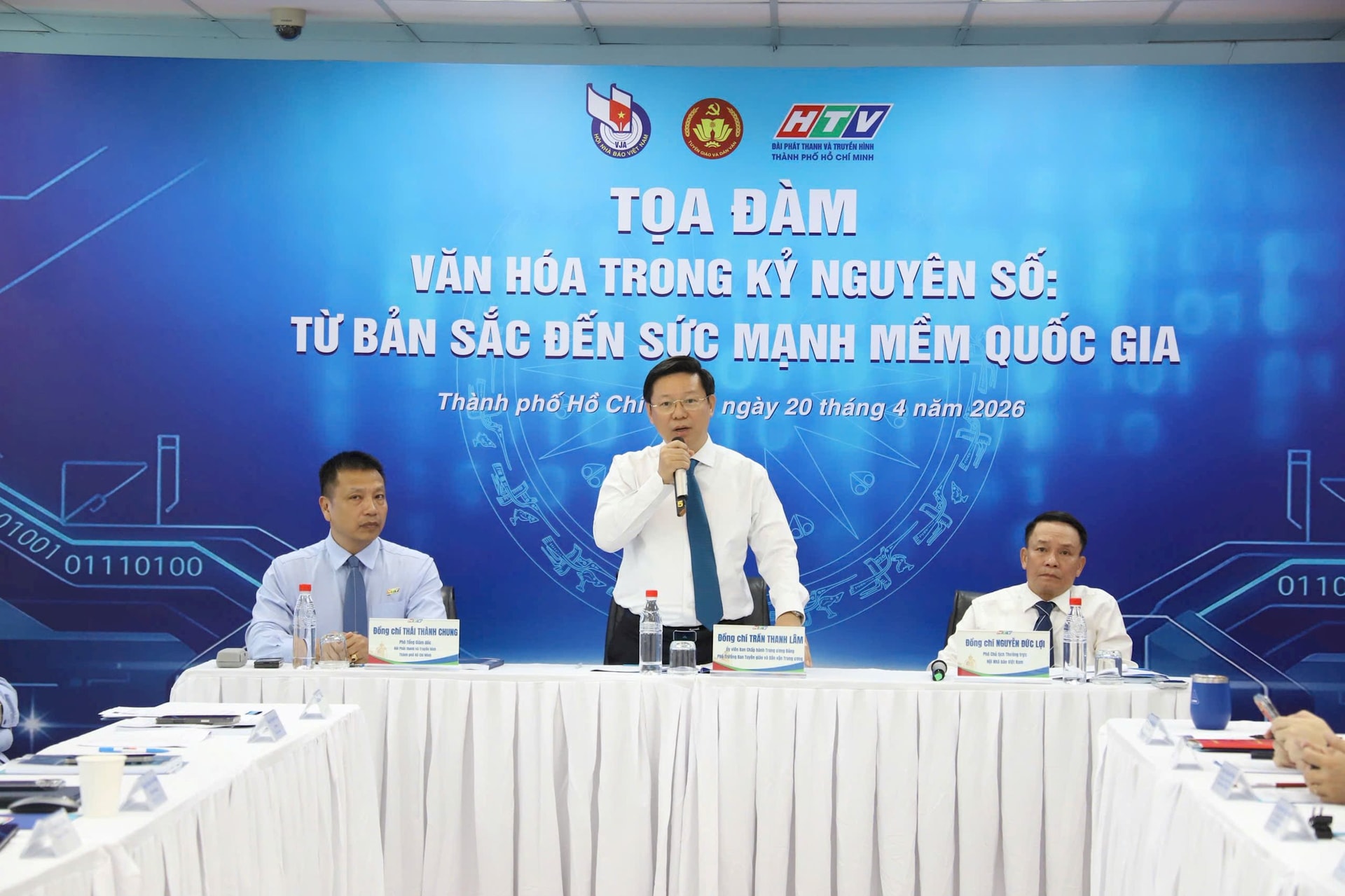
Delegates chairing the seminar
In this context, the presentation by Mr. Nguyễn Văn Khoa, CEO of FPT, drew attention for its technology- and market-oriented perspective.

Mr. Nguyễn Văn Khoa, CEO of FPT, presenting at the seminar
Opening his remarks, Mr. Nguyễn Văn Khoa emphasized that in the digital era, technology does not replace culture—it determines how culture is disseminated.
According to him, the biggest bottleneck today is not a lack of content, but rather digital distribution—the factor that determines whether content reaches the right audience.
Citing a real-world example, he referred to the film Đào, phở và piano, which, despite limited marketing investment, generated tens of billions of VND in revenue thanks to organic spread on digital platforms.
“Investing in production is only half the story. The other half—digital distribution—is where we are falling short,” he stated, reiterating: “Technology does not create content, it distributes it.”
When cultural identity becomes a consumable product
From an economic perspective, the FPT leader argued that culture only becomes a resource when it is transformed into data, digital content, and experiences.
In practice, many localities have begun to succeed in “productizing” heritage. According to tourism data, Vietnam’s total tourism revenue has surpassed VND 1 quadrillion in recent years, with destinations effectively leveraging cultural experiences seeing strong growth.
Models such as light shows, night-time cultural spaces, and digitized festivals not only attract visitors but also generate strong viral effects on social media.
“Technology does not erode identity. On the contrary, it helps identity last longer and travel further,” Mr. Khoa noted.
In this sense, culture is no longer just a “soft value” in the spiritual domain but is becoming a form of soft economic infrastructure that can generate revenue and directly contribute to growth.
AI does not replace humans, it redistributes value
Another notable topic was the impact of artificial intelligence (AI) on journalism and content creation.
According to Mr. Nguyễn Văn Khoa, AI mainly automates intermediary tasks such as translation, summarization, basic editing, and distribution. This aligns with global trends, as many newsrooms are already applying AI to optimize content production workflows.
However, the core value—original content, perspectives, and real-world experiences—remains human-driven. “AI does not diminish the value of journalism; it raises the bar,” he said.
This implies that aggregated content will gradually lose its advantage, while in-depth and investigative content will become increasingly valuable.
Soft power does not come from a single “hit”
In relation to cultural industry development, the FPT leader emphasized that it is unrealistic to expect a few globally breakthrough products.
International experience shows that soft power is built on a strong domestic market foundation and long-term investment, rather than relying on a single phenomenon.
“There is no need to search for a ‘Vietnamese Squid Game.’ What matters is having many good products, consistently over time. When the foundation is strong enough, iconic success will emerge naturally,” he explained.
Avoiding the “technology trap” in digital culture development
Drawing from practical observations, Mr. Khoa pointed out several limitations:
- Developing cultural applications without sustainable operations, leading to abandonment
- The tendency to standardize models across localities, reducing cultural diversity
- A focus on large-scale projects while overlooking smaller, effective, and sustainable initiatives
According to him, technology is not a one-off project but an ecosystem that requires continuous operation.
Journalism and the issue of cultural data sovereignty
Concluding his presentation, Nguyễn Văn Khoa highlighted a long-term issue: cultural data sovereignty.
As AI systems increasingly influence how information is accessed, the lack of high-quality Vietnamese-language data could lead to misinterpretations about Vietnam.
In this context, journalism plays a critical role as it holds a highly reliable data repository. Digitizing and effectively leveraging this resource not only serves readers but also helps shape how Vietnam is understood in the digital space.
The FPT CEO also noted that Vietnamese audiences—especially younger generations—are already ready to embrace and spread domestic cultural products. The remaining challenge lies on the supply side: product quality and digital approach.
“We don’t need to convince them to love Vietnamese culture. They already do. What we need is to create content and experiences worthy of that love,” he concluded.

Highlight news
FPT News | 03/07/2025