
FPT Chairman Trương Gia Bình: The Digital Platform for Civil Judgment Enforcement is a Milestone in Implementing Resolution 57-NQ/TW
•
03/04/2026
Hanoi, April 3, 2026 – The Ministry of Justice held the launch ceremony of the Civil Judgment Enforcement digital platform (THADS), marking a milestone in the strong digital transformation of civil judgment enforcement activities, aimed at improving public satisfaction through modernization, smart operations, digitalization, AI application, and data connectivity under the principle “Accurate – Sufficient – Clean – Live.” The platform is now in operation, effectively meeting key requirements such as the two-tier government model, administrative procedure simplification, implementation of amendments to the Law on Civil Judgment Enforcement, and pioneering the realization of Resolution No. 57-NQ/TW of the Politburo.
The ceremony was attended by Hồ Quốc Dũng, Member of the Party Central Committee and Deputy Prime Minister; Nguyễn Hải Ninh, Minister of Justice and Standing Vice Chairman of the Central Council for Legal Dissemination and Education; Nguyễn Mạnh Hùng, Minister of Science and Technology; Mai Lương Khôi, Deputy Minister of Justice; Nguyễn Quang Thái, Deputy Secretary of the Party Committee of the Ministry of Justice; and Nguyễn Thắng Lợi, Director General of the Civil Judgment Enforcement Management Department; along with representatives from central agencies including the Party Central Office, the National Assembly’s Committee for Judicial Affairs and Law, the Government Steering Committee for Science, Technology and Digital Transformation, the Ministry of Science and Technology, the Ministry of Public Security, the Supreme People’s Procuracy, the Supreme People’s Court, as well as units under the Ministry of Justice and relevant agencies.

The Civil Judgment Enforcement digital platform is officially launched nationwide.
The launch ceremony was held in a hybrid format, combining in-person and online participation, connecting to 34/34 provinces and cities nationwide, with the participation of hundreds of delegates across the sector. Towards the 80th anniversary of the Civil Judgment Enforcement Tradition Day (July 19, 1946 – July 19, 2026), the launch of the digital platform carries significant meaning, marking a traditional milestone and representing a concrete step demonstrating strong determination to innovate management, direction, and administration methods in civil judgment enforcement in the new phase.
The Civil Judgment Enforcement digital platform was developed in the context where digital transformation in this field has been identified by the Ministry of Justice as an inevitable requirement. It marks the transition from experience-based management to real-time data-driven governance, from fragmented processes to integrated, seamless, and transparent operations.
Resolution No. 57-NQ/TW on breakthroughs in science, technology, innovation, and national digital transformation, and Resolution No. 66-NQ/TW on reforming law-making and law enforcement in the new era, set requirements for fundamentally transforming legal development and enforcement methods toward modern governance based on data, transparency, and openness.
At the same time, practical civil judgment enforcement in recent years has faced increasing pressure, with a growing volume of cases and enforcement values, many of which are large-scale and complex, while traditional, manual-heavy governance models have revealed clear limitations. Notably, from July 1, 2026, the civil judgment enforcement system will be reorganized into a single-tier model at the local level, requiring fully synchronized digital infrastructure. The amended Law on Civil Judgment Enforcement introduces provisions promoting comprehensive digital transformation, focusing on data standardization, digitization of records, integration of operational systems, and the gradual formation of a smart enforcement governance platform centered on data, thereby enhancing effectiveness and efficiency across the sector.
Under the direction of the Standing Committee of the Ministry of Justice Party Committee, the digital platform has been implemented on an accelerated roadmap, with key milestones including: nationwide deployment of electronic receipts from July 1, 2025; activation of the digital platform and the Civil Judgment Enforcement Intelligent Monitoring and Operations Center (IOC) on December 12, 2025; and official nationwide operation of the platform from January 20, 2026, coinciding with the effective date of digital transformation provisions in the amended Law.
Unlike a standalone technology application, the platform is designed as a unified operational and administrative infrastructure for the entire enforcement system in the digital environment. It currently includes subsystems such as finance–accounting with electronic receipts; enforcement decision support; enforcement organization; citizen reception and complaint resolution; and the IOC smart monitoring and operations center.

Via online connection, Mr. Phan Xuân Thủy (Nghệ An), a related party, shares his experience in exercising rights and obligations through the digital platform and VNeID integration.
From October 1, 2025 to March 31, 2026, the platform recorded nearly 900,000 electronic receipts issued, with total collections reaching nearly VND 60 trillion. 100% of enforcement decisions have been issued digitally, with more than 800,000 case files and over 2 million documents digitized and managed on the system. All processes for citizen reception and complaint handling have been conducted entirely in the digital environment.
The synchronization of platform development with the effective date of the amended Law demonstrates a pioneering approach, where technology systems are implemented in parallel with policy from the outset, rather than lagging behind as in the past.
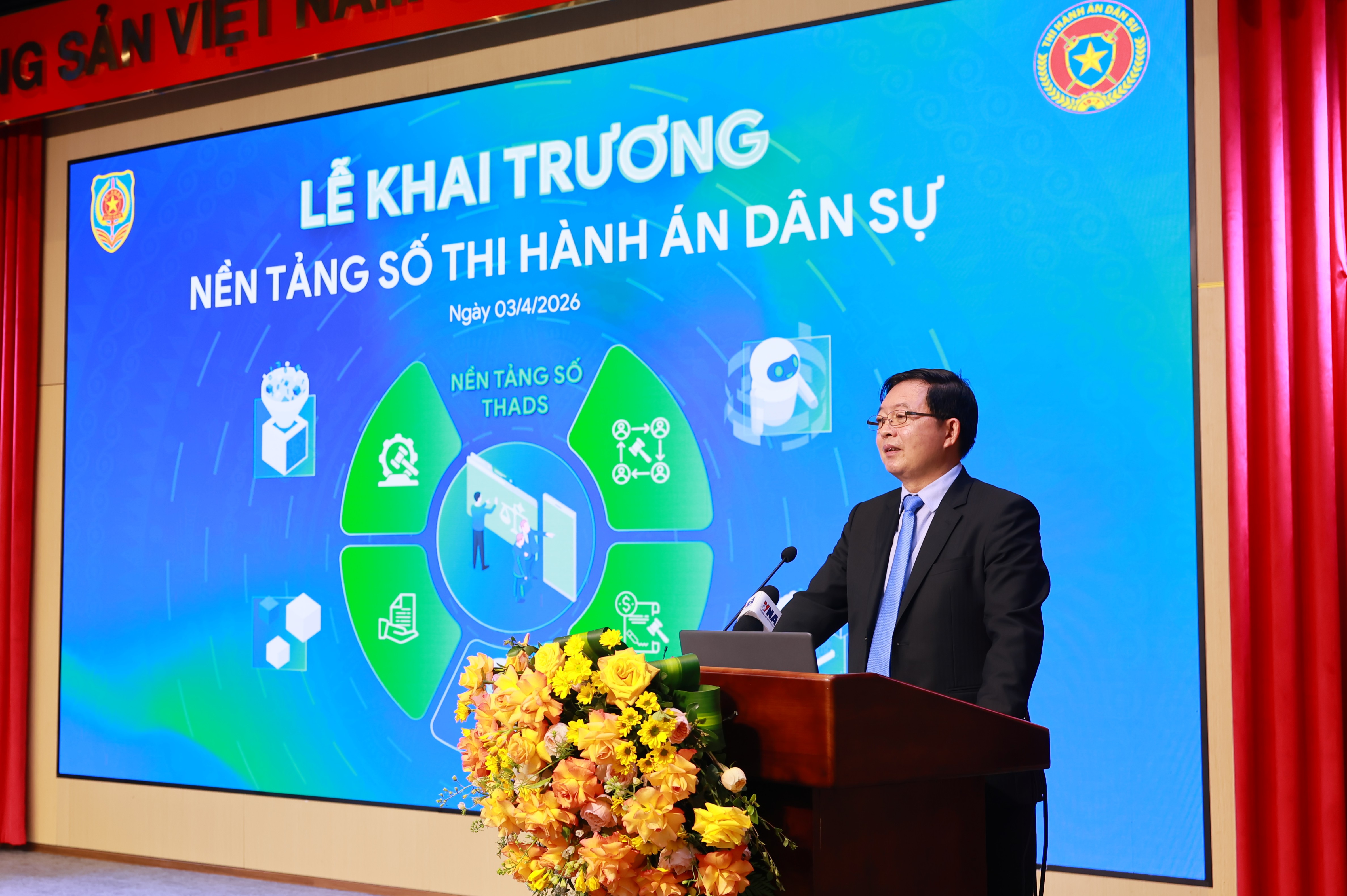
Mr. Hồ Quốc Dũng, Deputy Prime Minister, speaks about the Civil Judgment Enforcement digital platform.
Deputy Prime Minister Hồ Quốc Dũng emphasized: “The operation of the Civil Judgment Enforcement digital platform not only reflects innovation in mindset and technology but also represents a fundamental shift from traditional management to modern data-driven governance, from conventional to real-time operations, and from manual processing to the application of technology and artificial intelligence across the entire enforcement process—an essential field ensuring the strictness of law enforcement and the effectiveness of judicial decisions.”
Through online connections, representatives from Ho Chi Minh City’s civil judgment enforcement system and accounting officers shared practical results and achievements from implementing the platform. From the Nghệ An connection point, Mr. Phan Xuân Thủy shared his experience: “I was very surprised that within just two hours of submitting an electronic application, I received notifications from acceptance to payment request, and the next day I received an electronic receipt via the VNeID application. The platform is very convenient, especially for someone like me who lives far away, is elderly, and has difficulty traveling.”

Mr. Trương Gia Bình, Chairman of FPT, speaks at the launch ceremony.
Chairman Trương Gia Bình stated: “The Civil Judgment Enforcement digital platform is a remarkable achievement in implementing Resolution 57. What previously took four years has now been completed in just one year and operates smoothly after six months. Digital transformation is truly effective only when there is no paperwork and no in-person interaction—and the Ministry of Justice has achieved that.”
He emphasized two key lessons: strong and decisive leadership from the Ministry of Justice, with close coordination from the Ministry of Public Security and relevant units; and innovation in approach, with technology developed in parallel with institutional frameworks to fully leverage its power.
The platform establishes an end-to-end digital environment with four major breakthroughs: full digitization of processes from case intake to enforcement and result delivery; integration with the National Data Center, public services, and VNeID for online fee payment and electronic document delivery; intelligent governance via the IOC with real-time dashboards for monitoring and decision-making; and AI applications that reduce processing time by up to 80%, cut manual operations by up to 90%, and enable automated judgment analysis and draft decisions within 20 minutes. These advancements standardize processes, enhance data connectivity, ensure transparency, and strengthen discipline in public service execution, moving toward a modern, citizen-centric enforcement system.
This is the first ministerial-level platform to apply a low-code/no-code model built on technology developed by FPT, allowing flexible configuration of business processes, faster deployment, and rapid adaptation to institutional and organizational changes, demonstrating FPT’s capability in mastering strategic technologies.
To ensure the platform’s effectiveness, Deputy Prime Minister Hồ Quốc Dũng requested the Ministry of Justice and relevant agencies to continue improving the platform based on principles of stability, safety, effectiveness, and practicality; strengthen data connectivity and sharing across ministries, sectors, and localities; finalize the legal framework for digital transformation in civil judgment enforcement; and prioritize data quality—ensuring it is “accurate, sufficient, clean, and live,” while clearly assigning responsibility to leaders for data management and utilization.

Mr. Nguyễn Hải Ninh, Minister of Justice, directs the implementation to ensure the platform’s effectiveness.
Minister Nguyễn Hải Ninh affirmed that he will direct the Civil Judgment Enforcement Department to develop implementation plans, improve enforcement quality, and measure effectiveness through public satisfaction and practical outcomes assigned by the Government.
Digital transformation in civil judgment enforcement is not only a trend but an inevitable step toward a modern, professional, and service-oriented judicial administration. With the leadership of the Party and State, coordination among ministries, sectors, and localities, and the determination of all officials and employees in the system, the Civil Judgment Enforcement digital platform is expected to be successfully implemented, contributing to a modern, transparent, and efficient enforcement system that best serves people and businesses.