FPT, Cisco and Phenikaa University Advance Smart University Development in the AI Era
•
19/05/2026
Recently, the seminar “Digital Transformation in the Age of Artificial Intelligence: Solutions and Resources”, jointly organized by the Interdisciplinary School of Digital Technology under Phenikaa University, FPT, and Cisco, attracted more than 500 students and representatives from the Ministry of Education and Training, universities, and leading technology enterprises. The event provided practical perspectives on smart universities, AI infrastructure, data security, and the EdTech ecosystem, in alignment with Resolution No. 57-NQ/TW.
Attendees included Dr. Tô Hồng Nam, Deputy Director General of the Department of Science, Technology and Information under the Ministry of Education and Training; Prof. Dr. Lê Trung Thành, Standing Vice President and Executive Director of Phenikaa University; Dr. Nguyễn Ngọc Ninh, Vice President of Phenikaa University; Prof. Dr. Nguyễn Văn Hiếu, Vice President of Phenikaa University and Head of the Interdisciplinary School of Digital Technology; Mr. Đào Văn Thịnh, Director of Digital Infrastructure Services, FPT IS, FPT Corporation; and Mr. Hồ Hữu Thắng, Chief Technology Officer of Cisco Vietnam, together with experts from FPT, Cisco, and leaders from various faculties and institutes of Phenikaa University.
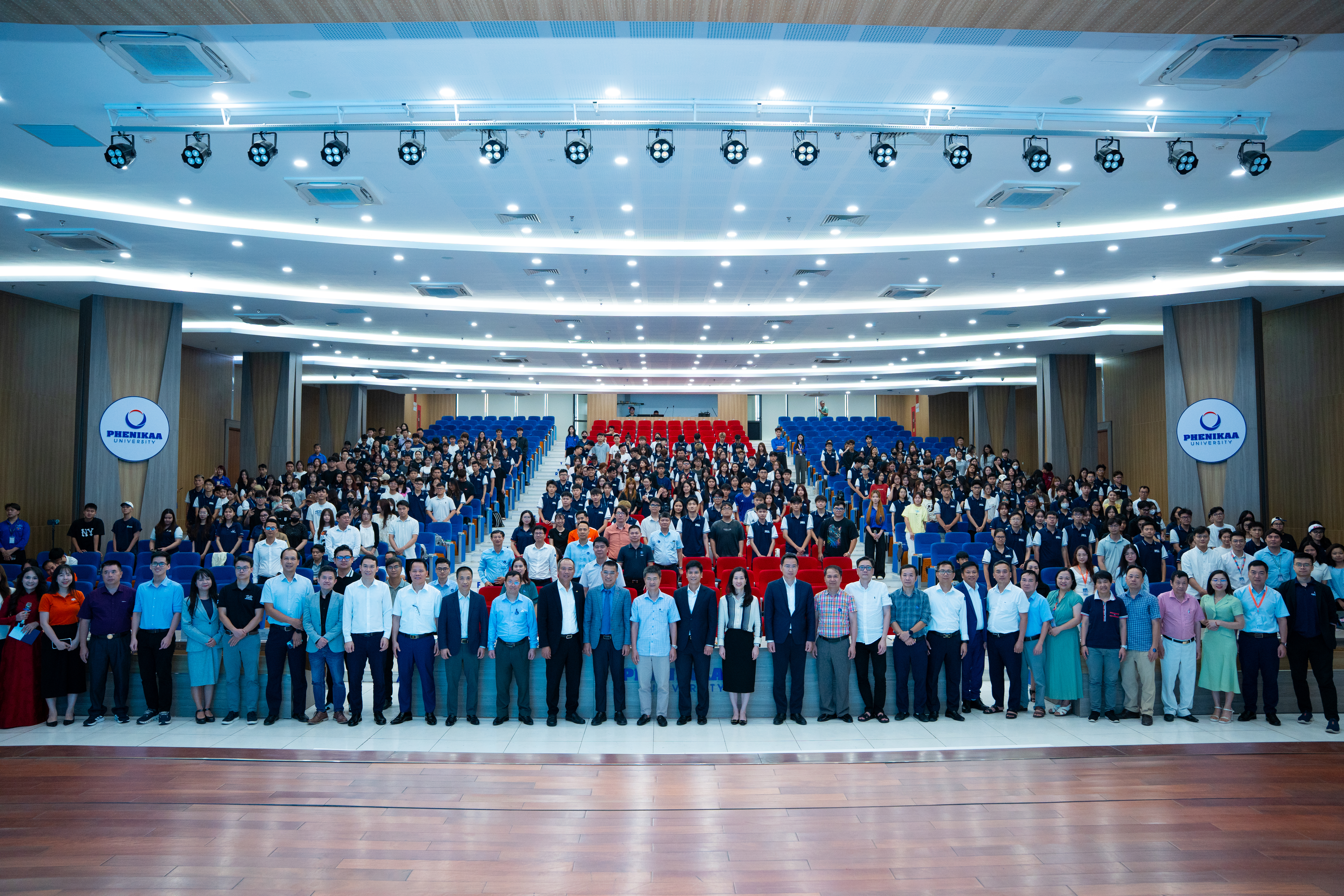
Delegates, experts, and students participating in the seminar
When AI Becomes Educational Infrastructure
In his opening remarks, Prof. Dr. Nguyễn Văn Hiếu affirmed that AI is no longer merely a supporting tool but has become a “new knowledge infrastructure,” directly impacting teaching, research, governance, and personalized education. According to him, today’s greatest challenge is not the lack of AI tools but the absence of AI governance models capable of being deployed consistently across institutions.
“Universities need to shift from isolated technology applications toward building smart digital university ecosystems, where data, digital platforms, AI, and people operate within a unified structure,” Prof. Hiếu emphasized.
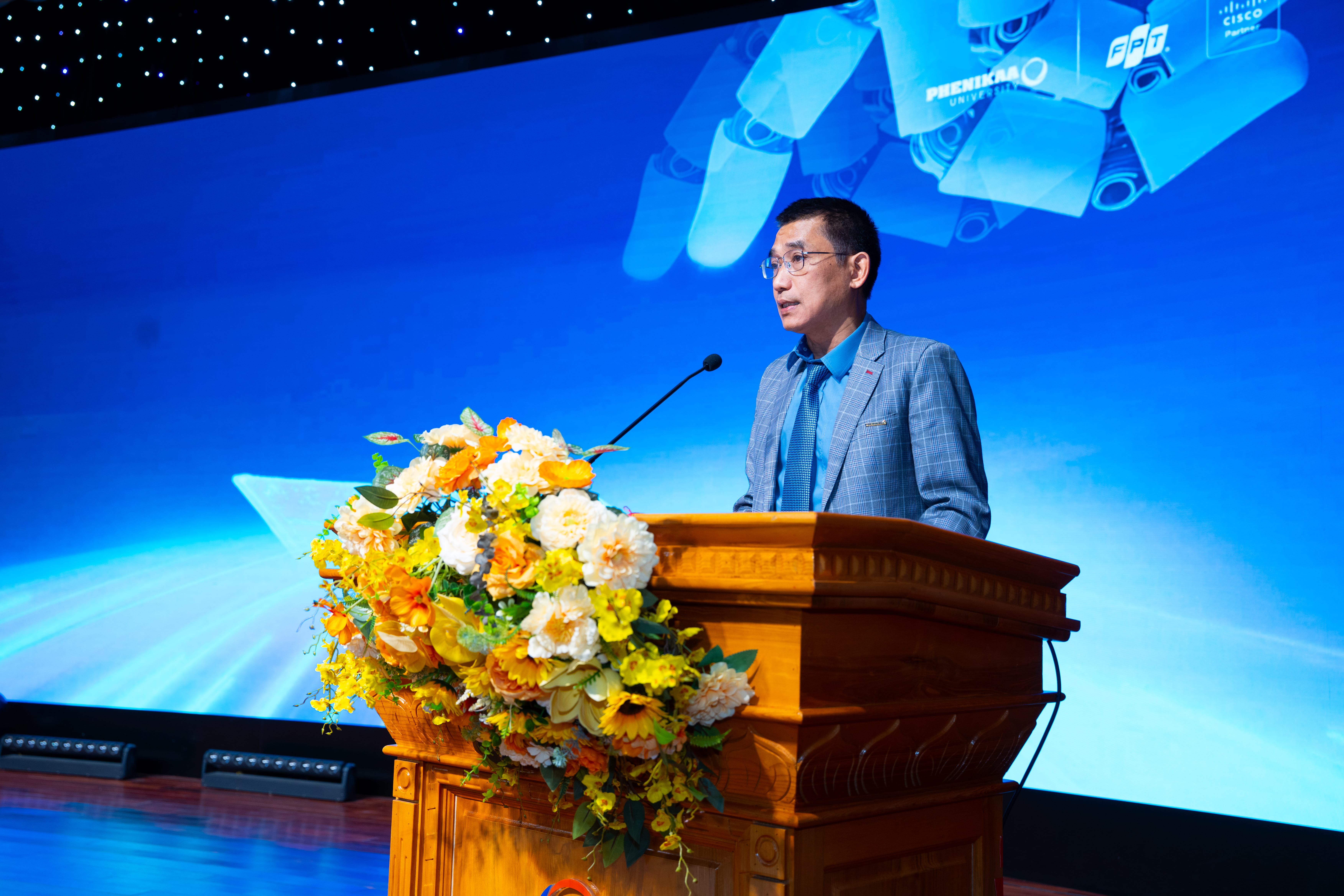
Prof. Dr. Nguyễn Văn Hiếu, Vice President of Phenikaa University and Head of the Interdisciplinary School of Digital Technology, emphasized that AI has become a “new knowledge infrastructure.”
From an enterprise perspective, Mr. Đào Văn Thịnh of FPT Corporation noted that Vietnam currently ranks among the Top 10 fastest-growing EdTech markets globally and Top 3 in Southeast Asia. This presents both opportunities and significant pressure for educational institutions and technology providers.
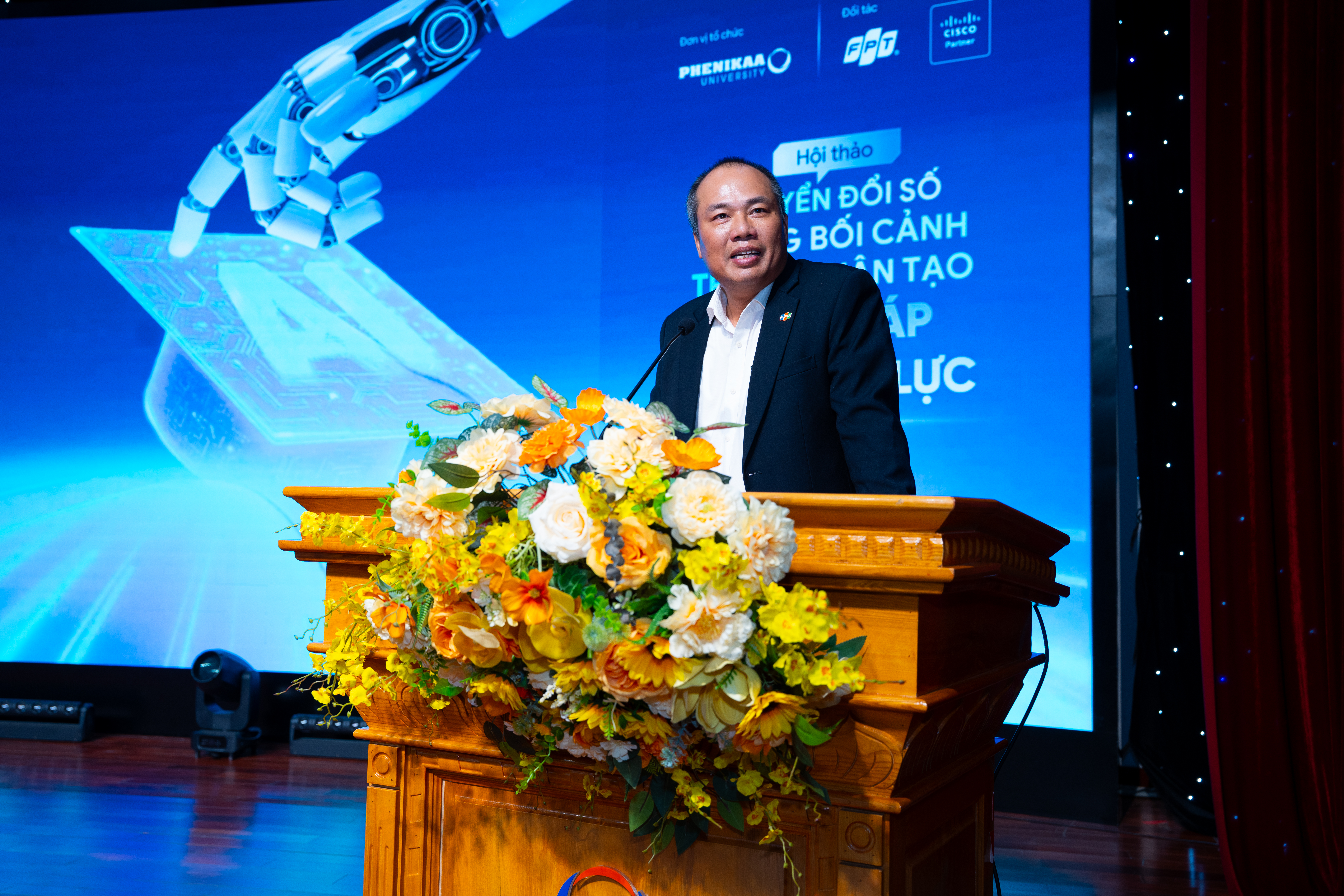
Mr. Đào Văn Thịnh, Director of Digital Infrastructure Services, FPT IS, FPT Corporation, reaffirmed FPT’s commitment to education as a strategic sector.
FPT considers education a strategic domain and invests in two parallel directions: the FPT Edu education system and a comprehensive EdTech ecosystem covering the full lifecycle of educational institutions.
Key platforms include VioEdu, an AI-powered personalized learning platform serving millions of users; Khaothi.Online with tens of millions of online test sessions; CodeLearn; Meduverse; and Kyta Platform developed by Vietnamese engineers.
On the infrastructure side, FPT operates a team of over 250 cybersecurity specialists and a 24/7 monitoring center while mastering core technologies including AI/ML, IoT, RPA, Blockchain, and Cloud. According to Mr. Thịnh, FPT does not merely provide technology solutions but accompanies educational institutions from strategic planning through implementation and continuous improvement.
From Cisco’s perspective, Mr. Hồ Hữu Thắng outlined three key constraints that may slow AI innovation in the next stage of development.
The first is infrastructure limitations — whether organizations possess sufficient computing power, networking capacity, and energy resources to support AI workloads.
The second is trust — whether organizations and users are prepared to entrust AI with operational processes and data.
The third is the data gap — how organizations can process and understand the rapidly growing volume of machine-generated data.
To address these challenges, Cisco focuses on three pillars:
- AI-Ready Data Centers: integrating networking, computing, security, and observability capabilities
- Future-Proofed Workplaces: modernizing operations and collaboration environments
- Digital Resilience: proactively preventing and responding to operational risks
“Sharing and Common Use” as a Core Breakthrough
Educational data in Vietnam has long remained fragmented, with each institution independently building systems and infrastructure, resulting in inefficient use of resources.
According to Dr. Tô Hồng Nam, this seminar represented more than an academic event; it reflected practical collaboration among government, educational institutions, and businesses in line with Resolution No. 57-NQ/TW.
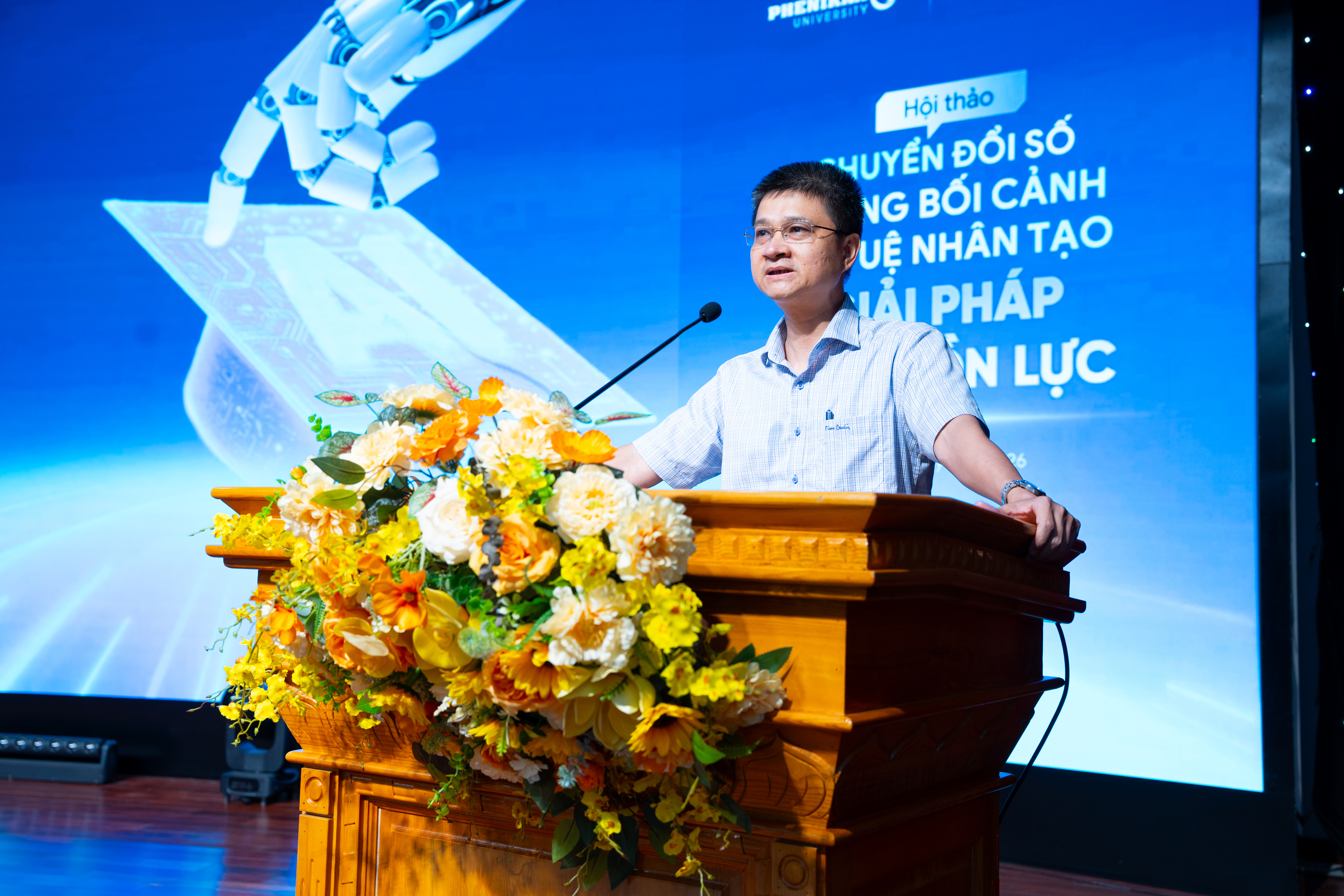
Dr. Tô Hồng Nam, Deputy Director General of the Department of Science, Technology and Information under the Ministry of Education and Training, emphasized the principle of “sharing and common use” in educational digital transformation.
He stressed that “sharing and common use” should be treated as a fundamental breakthrough priority.
The Ministry of Education and Training is promoting EMIS databases and a MOOC model dedicated to Vietnamese higher education, similar to Coursera, enabling resource sharing and mutual credit recognition.
Instead of each institution building costly standalone data centers, he recommended transitioning to flexible cloud infrastructure with clear security commitments from providers.
“Digital competency among lecturers and students—not technology systems themselves—is the decisive factor in successful digital transformation,” Dr. Nam emphasized.
From Governance Thinking to Infrastructure and Security
To further elaborate on these issues, experts from Phenikaa University, FPT, and Cisco presented three in-depth reports covering governance models, technology ecosystems, infrastructure, and cybersecurity.
In the first report, Dr. Nguyễn Duy Hải emphasized that STEM should not merely be regarded as a teaching methodology but as an approach that applies scientific, technological, engineering, and mathematical thinking to decision-making processes.
He noted that most universities remain at the stage of applying technology rather than restructuring operations around data.
To realize smart university models, institutions need to optimize five core areas: academic management, learner experience, operational resources, research and innovation, and enterprise connectivity, while standardizing approximately 500 digital processes and establishing AI governance frameworks.
“AI can only deliver its full value when data is interconnected, standardized, and integrated across the university ecosystem,” he emphasized.
The second report, presented by Ms. Hà Thị Hạnh and Dr. Nguyễn Thanh Bình from FPT IS, focused on EdTech ecosystems and cybersecurity.
According to the Vietnam EdTech White Paper, over 60% of domestic educational systems have adopted AI. However, the critical question is not where AI should be used but how it should be applied effectively.
Ms. Hạnh noted that learning in game-based environments can increase concentration levels fourfold compared with traditional methods, explaining FPT’s investments in AR/VR solutions.
Khaothi.Online currently manages more than 50 million examinations, including fully automated TSA examinations covering ID verification, kiosk check-in, monitoring, and grading.
Regarding cybersecurity, Dr. Bình cited data showing that 98% of universities and 88% of colleges in the UK experienced cyberattacks during the 2025–2026 academic year, with average remediation costs of USD 3.8 million per incident.
He recommended institutions establish multi-layered defense models and integrate cybersecurity directly into operational architecture from the outset.
In the third report, Cisco experts Mr. Trịnh Tuấn Anh, Mr. Nguyễn Tuân, and Mr. Chử Kiên Bình highlighted the gap between AI ambitions and implementation readiness.
IDC projects global AI infrastructure investment will reach USD 200 billion by 2028, yet only 32% of organizations are currently prepared.
Cisco recommended institutions adopt fine-tuning approaches instead of training models from scratch, reducing infrastructure investment burdens while still meeting educational AI requirements.
From Solutions to Action
The open discussion session featuring representatives from the Ministry of Education and Training, Phenikaa University, FPT, Cisco, and students explored key questions surrounding the future of smart universities, AI readiness, and balancing innovation with data protection.
A common conclusion among experts was that critical thinking in the AI era—including questioning and validating AI-generated outputs—will become an essential capability.
Alongside the seminar, FPT’s “Co-create the next in education with AI” exhibition enabled students to directly experience Smart LMS, Kyta Platform, AkaVerse, FPT.eLearning, s-Edu, AIViệc, as well as AR/VR demonstrations and smart classroom models.
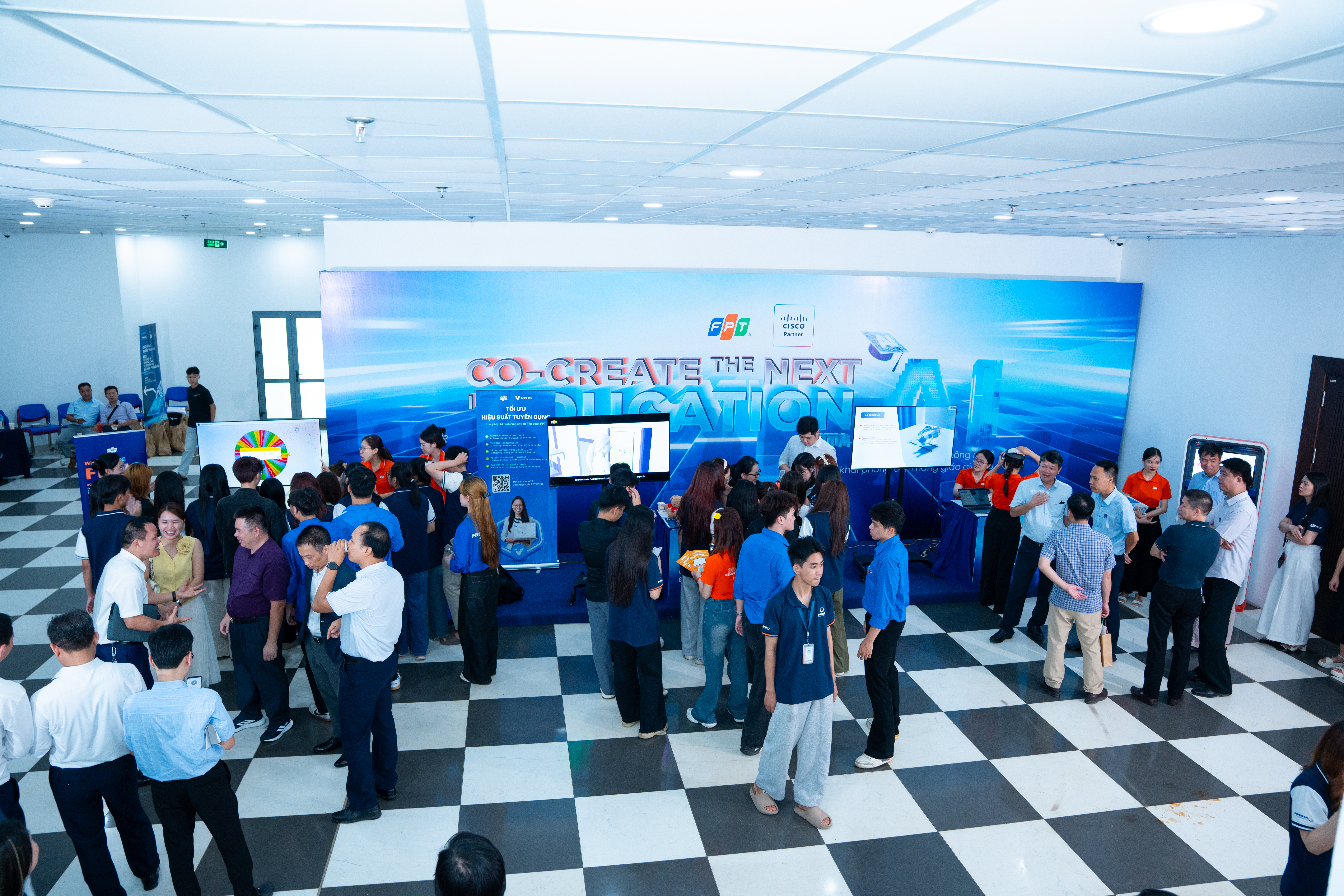
FPT’s “Co-create the next in education with AI” exhibition attracted significant interest from students and delegates.
Concluding the event, Prof. Dr. Nguyễn Văn Hiếu stated that the seminar served not only as a platform for discussing technological solutions but also as an opportunity for students to gain a clearer understanding of labor market demands in the AI era.
With a comprehensive EdTech ecosystem and extensive implementation experience across hundreds of educational institutions, FPT—and Vietnamese technology enterprises more broadly—continue to reinforce their position as strategic partners and leaders in driving digital transformation in higher education.