
FPT Helps Businesses Accelerate Readiness for Mandatory Electronic Employment Contracts Effective July 1, 2026
•
23/06/2026
With only a few days remaining before the nationwide implementation of Decree No. 337/2025/ND-CP and Circular No. 08/2026/TT-BNV on July 1, 2026, businesses across Vietnam are accelerating reviews of their HR processes, technology infrastructure, and deployment plans to comply with the new requirements governing electronic employment contracts.
The strong interest from the business community was reflected in FPT's webinar, "Electronic Employment Contracts under Decree No. 337/2025/ND-CP: From Legal Compliance to Smart HR Operations," which attracted nearly 700 business representatives nationwide and generated hundreds of questions covering legal, technical, and operational aspects of implementation.

FPT supports businesses in preparing for the nationwide rollout of electronic employment contracts on July 1, 2026.
New Regulatory Framework for Electronic Employment Contracts
As digital transformation continues to reshape human resource management, electronic employment contracts have gained increasing adoption thanks to their ability to streamline signing processes, centralize document management, and improve operational efficiency. However, businesses have continued to face questions regarding legal validity, technical requirements, identity verification, and interoperability with government systems.

Ms. Vu Thi Phuong Oanh, Labor, Compensation, and Social Insurance Expert, provides an overview of the new regulations governing electronic employment contracts.
During the webinar, Ms. Vu Thi Phuong Oanh explained that Decree No. 337/2025/ND-CP and Circular No. 08/2026/TT-BNV establish a more comprehensive legal framework for electronic employment contracts, providing clearer guidance on contract execution, data management, and digital information utilization.
Beginning July 1, 2026, regulations governing connectivity, identification code (ID) issuance, management, and utilization of the National Electronic Employment Contract Platform will officially take effect.
To be legally valid, an electronic employment contract must satisfy requirements for identity authentication, digital signatures, timestamps, electronic data message certification, and be assigned a unique identification code by the National Electronic Employment Contract Platform. This ID functions as the contract's unique identifier, enabling government agencies to retrieve, interconnect, and manage contract data while having no impact on the signed document's content or legal validity.
Ms. Oanh emphasized that July 1, 2026 marks the nationwide implementation date for the new regulatory framework, while businesses remain free to adopt electronic employment contracts according to their own readiness, operational characteristics, and business requirements.
Early adoption not only enables organizations to proactively comply with the new regulations but also delivers significant operational benefits. Centralized digital contract management helps optimize HR processes, reduce manual workloads, lower operating costs, and improve employee experience through faster and more convenient digital signing workflows.
From Business Concerns to Practical Implementation
Throughout the webinar, participants raised questions regarding changes to contract execution procedures after July 1, requirements for connecting to the National Electronic Employment Contract Platform, integration with existing HR systems, and the operational impact of transitioning from paper-based contracts to digital workflows.
Addressing these concerns, Mr. Nguyen Ta Anh, Deputy Director of the Enterprise Digital Solutions Center at FPT IS, FPT Corporation, noted that Decree No. 337/2025/ND-CP provides businesses with a unified legal framework that significantly clarifies the implementation process.
According to him, organizations should view electronic employment contracts not simply as a replacement for paper-based signatures, but as an opportunity to standardize HR data and modernize workforce management.
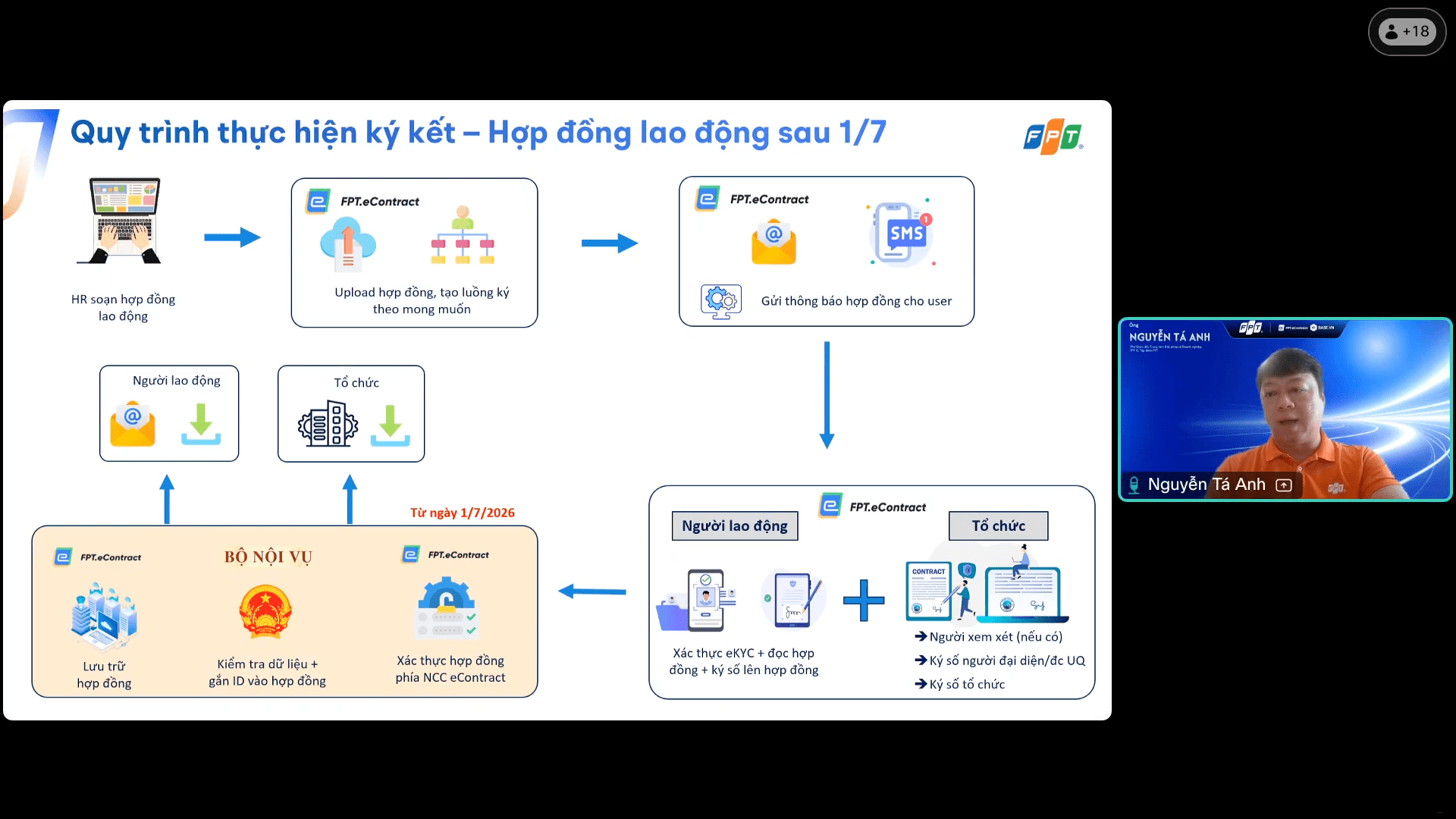
Mr. Nguyen Ta Anh of FPT Corporation highlights the key benefits of adopting electronic employment contracts.
Drawing on FPT's implementation experience, he recommended that businesses begin by reviewing existing workflows, assessing data readiness, and developing implementation roadmaps tailored to their operational scale and business requirements.
Using solutions such as FPT.eContract, organizations can configure customized approval workflows, distribute contracts through multiple communication channels, execute legally compliant digital signatures, centrally manage contract archives, and prepare for integration with the National Electronic Employment Contract Platform under the new regulations.
Mr. Ta Anh noted that implementation timelines typically range from one to twelve weeks, depending on organizational size and system readiness. Beyond technology deployment, user training and change management are critical factors for successful adoption, particularly for organizations with large or geographically dispersed workforces.
According to FPT's implementation data, electronic contracts can reduce contract execution time by up to 95% while lowering costs by approximately 80% compared with traditional paper-based processes. In addition to reducing printing, storage, and courier expenses, electronic contracts allow all parties to sign documents anytime and anywhere, improving both operational efficiency and employee experience.
FPT has successfully supported numerous organizations, including enterprises employing workers with diverse educational and technical backgrounds, demonstrating that the solution is accessible and easy to use across different workforce segments.

Mr. Dam Anh Tu, Product Owner of the HRMS platform, discusses the practical challenges businesses encounter during digital transformation.
From an operational perspective, Mr. Dam Anh Tu explained that the greatest challenge lies not in technology itself but in redesigning business processes and management practices.
Before digital transformation, many organizations relied heavily on manual procedures involving printed documents, physical circulation of paperwork, and fragmented contract tracking. Moving to a digital environment therefore requires more than implementing new software—it also requires standardizing HR data, redesigning operational workflows, and integrating electronic contract systems with existing HRMS platforms where applicable.
According to Mr. Tu, these preparations enable organizations to better leverage HR data while ensuring a smoother and more sustainable digital transformation journey.
Data security and regulatory compliance also remain top priorities. According to FPT representatives, compliant electronic contract solutions such as FPT.eContract must fully support identity authentication, digital signatures, timestamps, electronic data message certification, information security, electronic document management, and connectivity with both the National Electronic Employment Contract Platform and existing enterprise management systems in accordance with Decree No. 337/2025/ND-CP.
"Decree No. 337/2025/ND-CP should not be viewed as a regulatory burden, but rather as an opportunity for businesses to standardize HR data and establish a solid foundation for comprehensive digital transformation," Mr. Ta Anh said.
Toward End-to-End Digital HR Management
From an HR management perspective, the speakers emphasized that electronic employment contracts should not be treated as standalone documents but instead integrated throughout the entire employee lifecycle.
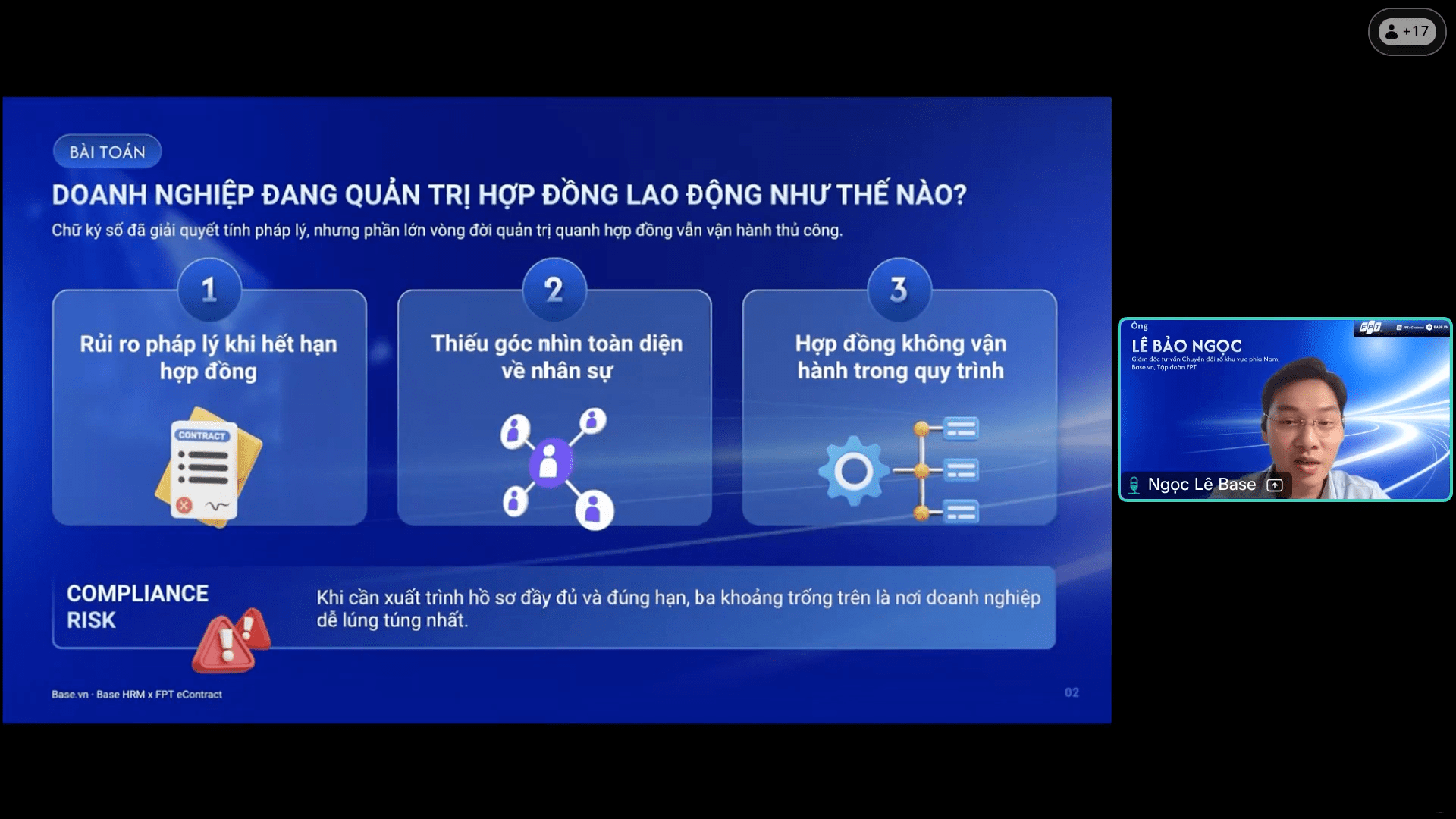
Mr. Le Bao Ngoc of FPT Corporation discusses the integration of HR management platforms with digital signature systems.
Mr. Le Bao Ngoc, Director of Digital Transformation Consulting at Base.vn, FPT Corporation, noted that synchronizing employment contracts with employee records significantly reduces manual work and minimizes administrative errors.
By integrating recruitment, probation, contract signing, renewal, and termination within a unified platform, organizations can automate numerous HR processes while maintaining end-to-end visibility throughout the employee lifecycle. Automated contract expiration alerts further enable HR teams to proactively manage renewals and reduce labor compliance risks.
A key capability highlighted by Mr. Ngoc is the seamless integration between HR management platforms and digital signature systems. Organizations can establish approval workflows, process bulk signing requests, and monitor the entire signing process within a single platform. Employees can receive notifications and complete digital signatures through multiple channels—including email, SMS, and Zalo—enhancing user experience and accelerating enterprise-wide digital transformation.
During the discussion, hundreds of questions focused on practical implementation issues, including digital signature selection, identity verification, timestamp services, electronic data certification, interoperability with the National Electronic Employment Contract Platform, and integration with existing HR management systems. This demonstrates that businesses are moving beyond understanding regulatory requirements and are now actively planning implementation strategies.
Survey results from the webinar showed that more than 91% of participating organizations are interested in learning more about digital transformation technologies. Among them, electronic employment contracts emerged as the most requested solution, accounting for 59.1% of responses.
According to the speakers, early adoption not only enables businesses to proactively comply with new regulations but also helps standardize HR data, optimize operational processes, reduce costs, and enhance employee experience. For organizations already using HR management or enterprise management platforms, electronic employment contracts can become a critical component of an integrated, modern digital HR ecosystem.
Businesses interested in receiving the presentation materials and webinar recording may contact: Contact@fpt.com