FPT Introduces CASAN AI Transformation Framework at GStar Summit 2026
•
01/06/2026
At GStar Summit 2026, an international technology forum bringing together some of the world’s leading AI experts, Mr. Nguyen Xuan Phong, Chief AI Transformation Officer (CAIXO) of FPT Corporation, introduced CASAN, FPT’s five-level AI-Native Capability Framework, designed to help organizations assess their current AI maturity and build structured AI transformation roadmaps.
GStar Summit 2026, held in Ho Chi Minh City, is one of the most significant technology events in the Asia-Pacific region. The summit was co-organized by the New Turing Institute (NTI), a pioneering non-profit organization building the AI ecosystem in Southeast Asia, and Pacific Gateway Partners (PGP), a strategic bridge between the United States and Asia. The event attracted more than 1,000 in-person attendees and approximately 20 speakers from organizations including Google DeepMind, Carnegie Mellon University, Qualcomm, FPT, as well as leading research institutes, enterprises, and international organizations.
As part of the summit, Mr. Nguyen Xuan Phong presented CASAN – the 5-Level AI-Native Capability Framework, which consists of five progressive stages: Curious, Augmented, Standard, Automatic, and Native. The framework is designed to help organizations clearly identify their level of AI maturity and establish an appropriate transformation roadmap.
According to FPT’s Chief AI Transformation Officer, AI is no longer merely a technology experiment. It is fundamentally reshaping how businesses operate, how decisions are made, how nations compete, and how people create value.
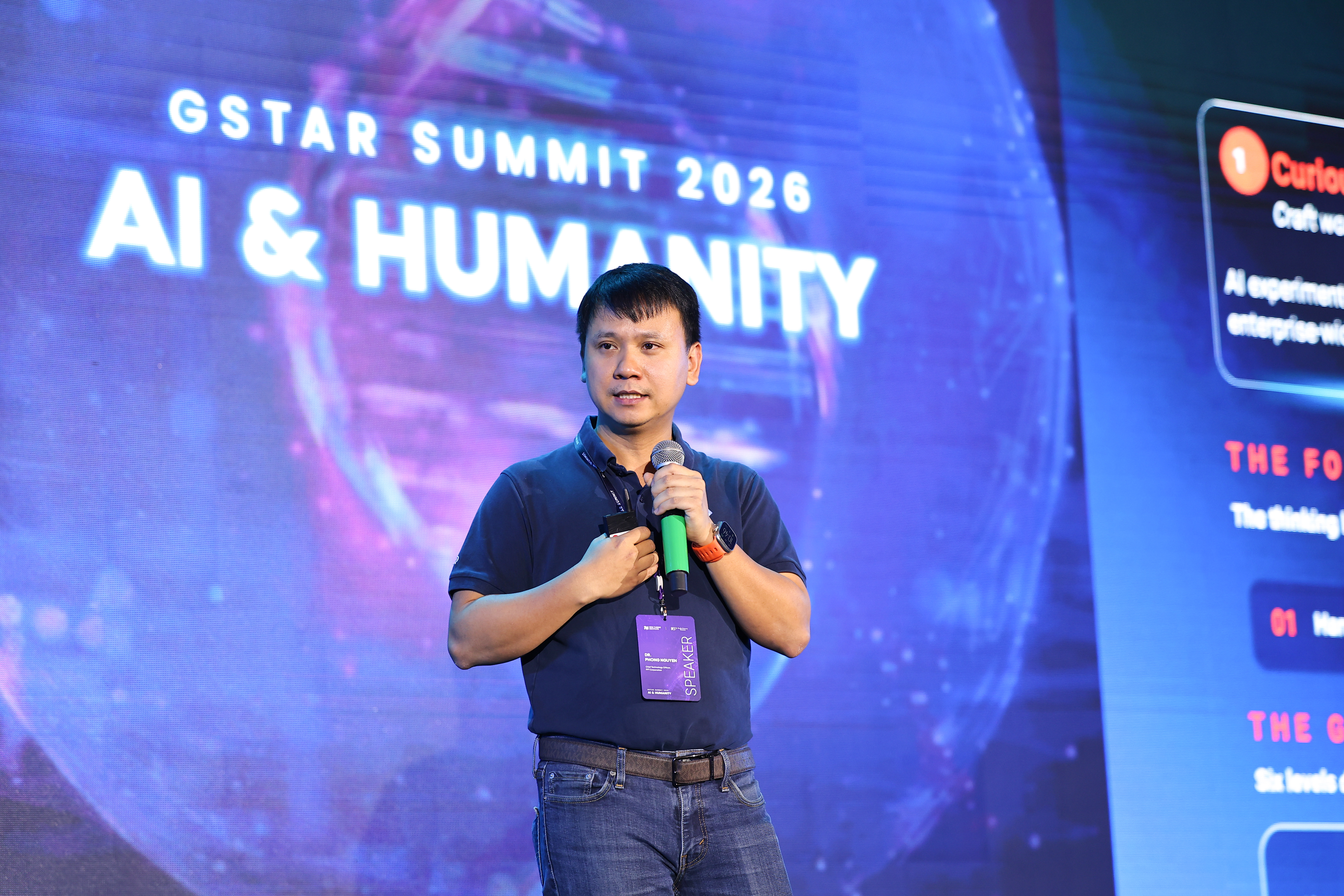
Mr. Nguyen Xuan Phong, Chief AI Transformation Officer (CAIXO) of FPT Corporation.
“CASAN helps organizations identify where they are today, define a transformation strategy, and answer four critical questions that enterprises frequently ask: Where are we on our AI journey? What must we do to reach the next level? What services, platforms, talent, and intellectual assets are required to meet the standards of each stage? And how will AI create value for our organization? CASAN serves as a compass, helping enterprises understand and navigate their AI transformation journey,” said Mr. Nguyen Xuan Phong.
According to surveys by Gartner and McKinsey, 87% of CEOs identify AI as a strategic priority. However, across industries such as education, healthcare, and manufacturing, only 12% of organizations have successfully deployed AI in real operational environments.
This gap highlights a major challenge—not technology itself, but the ability to understand both technology and human-centered change management. Most organizations still approach AI as a collection of isolated experiments. While market attention between 2022 and 2025 focused primarily on AI models, enterprises today face a different challenge: integrating AI into operational processes, generating tangible business value, and scaling adoption safely across the organization. This requires a structured roadmap that moves beyond model optimization toward practical AI deployment that supports engineers, technical teams, and business operations.
Mr. Phong emphasized that the primary challenge for organizations lies not in technology but in human transformation. In this new era, people must lead while AI takes on execution. Organizations need to reshape workforce mindsets, starting with managers and senior leaders. Leadership teams must become the first agents of change, followed by sales teams, consultants, architects, software developers, and other business functions. At the same time, organizations must treat AI as a strategic resource alongside capital and talent, making it a core component of every project.
FPT believes that advancing through each level of AI maturity requires a long-term strategy and a step-by-step approach. Throughout this journey, people must remain at the center—learning how to assign tasks to AI, evaluate outcomes, adjust operational models, and utilize AI as a critical organizational resource alongside capital, talent, and data.
To foster AI innovation and adoption within the Vietnamese community, FPT also introduced the Au Lac AI Grand Prize, a US$1 million award initiated by the Au Lac AI Alliance. The award aims to discover and honor AI products and solutions developed by Vietnamese innovators that generate sustainable economic and social impact.
The judging panel includes respected leaders, scientists, and experts such as Mr. Truong Gia Binh, Chairman of FPT Corporation, Mr. Don Lam, Co-founder and Chief Executive Officer of VinaCapital, and Dr. Luong Minh Thang, Principal Scientist and Research Director at Google DeepMind, among others.
“Every nation leading in AI today began with human talent. Through the Au Lac AI Grand Prize, FPT seeks to create a platform where the next generation can reach the global stage. We invite young innovators to participate, bring Vietnamese pride to the world, and help shape AI with a uniquely Vietnamese identity,” Mr. Nguyen Xuan Phong said.
.jpg)
The US$1 million Au Lac AI Grand Prize recognizes AI products and solutions developed by Vietnamese innovators that deliver sustainable economic and social impact.
Discussions at GStar Summit 2026 also expanded to a broader question: what role should humans play in the age of AI?
Dr. Luong Minh Thang, Principal Scientist and Research Director at Google DeepMind, Co-founder of the New Turing Institute, and member of the Grand Jury of the Au Lac AI Grand Prize, stated that the Asia-Pacific region is uniquely positioned to play a larger role in shaping the future of global AI.
According to Dr. Thang, stronger connections between world-class experts and regional innovators can create new opportunities for collaboration, enabling Asia to move beyond technology adoption and become an active contributor to global AI leadership. He expressed a vision of building a workforce of 100,000 highly skilled AI engineers in Vietnam by 2030, believing that such talent will drive the deployment of emerging technologies and help establish Vietnam as a deep-tech innovation hub.
Beyond talent development, he also highlighted the importance of strengthening foundational elements such as computing infrastructure, startup ecosystems, and deeper participation from the business community.
From a technology perspective, Dr. Ed H. Chi, Vice President of Research at Google DeepMind, discussed the evolution of AI from traditional chatbots toward systems capable of proactively planning and performing tasks on behalf of users. According to Dr. Chi, multimodal models are gradually transforming AI from a specialized tool into a personal assistant capable of understanding context, reasoning, and supporting people across multiple forms of data.
The summit’s discussions also explored a broad range of AI applications in daily life and the digital economy, including healthcare, digital finance, natural language technologies, and Agentic AI. These conversations highlighted how AI is increasingly becoming part of the digital economic infrastructure. However, participants agreed that the future of AI will be shaped not only by technological advances, but also by the choices people make regarding how AI is developed and applied.