Two FPT engineers make their mark at a leading global AI conference
•
25/02/2026
Engineers Nguyen Thi Ngan and Tran Van Khanh from FPT Smart Cloud, under FPT, made a strong impression at the 40th Annual Conference of the Association for the Advancement of Artificial Intelligence (AAAI-26) with research on optimizing language models and intelligent online education.
AAAI-26 was recently held in Singapore and is considered one of the world’s most prestigious academic AI events, bringing together leading research teams from major technology corporations and academic institutions. Representing Vietnam were Nguyen Thi Ngan and Dr. Tran Van Khanh, both working at the GenAI Center of FPT Smart Cloud.
Their research experiments were accelerated on FPT AI Factory, a GPU cloud infrastructure platform used to run and evaluate multiple model configurations. Having control over infrastructure enabled the team to shorten experimentation time, improve training stability, and scale evaluations more efficiently.
Nguyen Thi Ngan, 26, an AI engineer at the GenAI Center, presented her research titled “CTPD: Cross Tokenizer Preference Distillation.” The study addresses a promising yet challenging problem: how to develop AI models that are both compact and high-performing for cost-efficient real-world deployment.
Facing the reality that enterprises often incur high operational costs when using large-scale language models, Ngan and her team worked on distilling powerful models into smaller ones. These compact models retain user-aligned response quality while operating faster and with fewer resources. However, a key technical bottleneck arises from differences in tokenizers across models, which can distort training signal transfer.
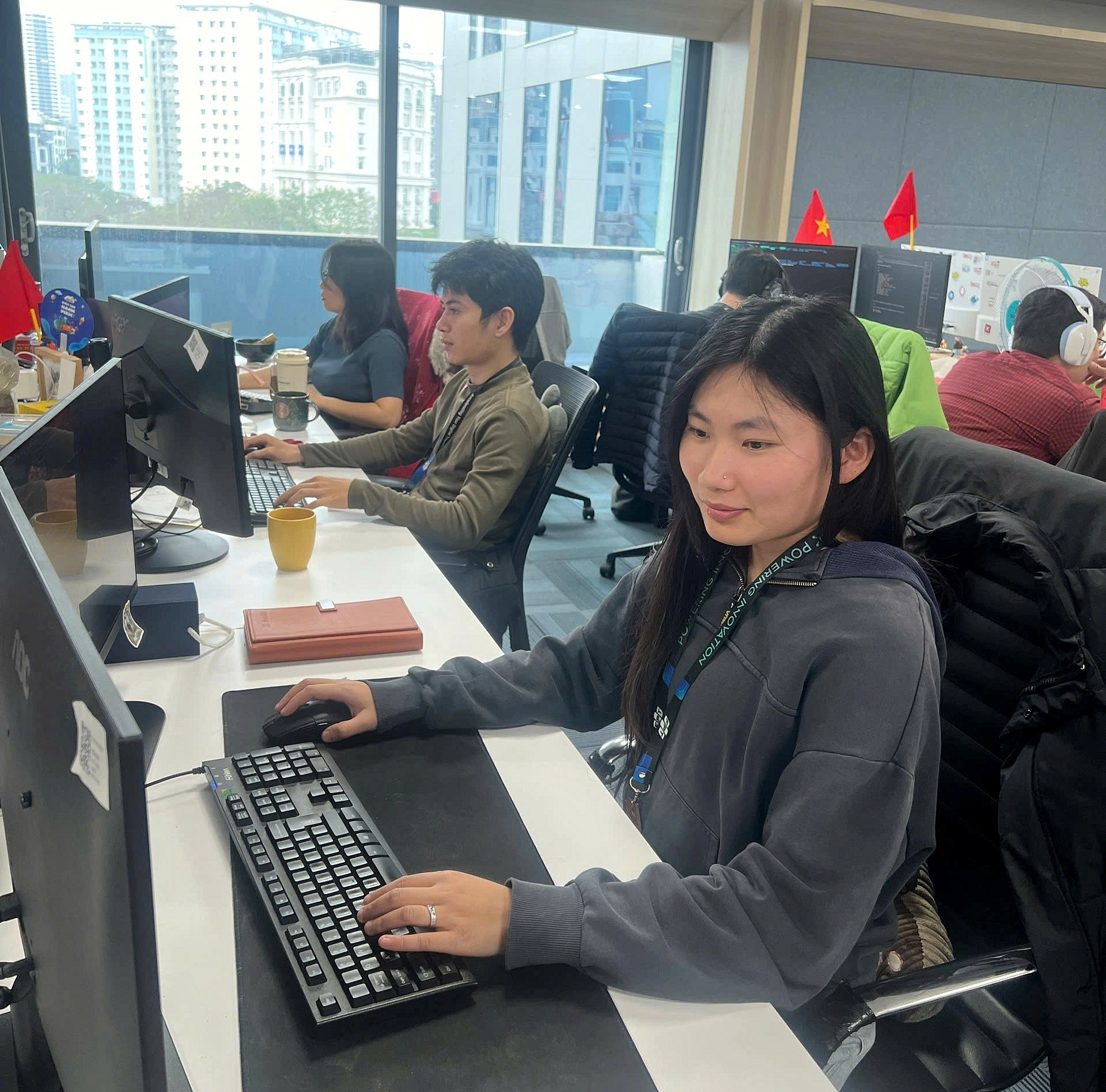
Nguyen Thi Ngan presents on behalf of the CTPD research team at AAAI-26.
Explaining the novelty of the approach, Ngan noted that instead of forcing models to share the same tokenization scheme, the team aligned them based on character positions in the original text. This allows smaller models to more accurately learn response styles from larger ones. “We aim to help the community reuse powerful existing models to build practical solutions for domains such as customer service, legal, and banking,” she said.
Prior to AAAI-26, the research team underwent three months of intensive work. At one point, just a week before submission, results had yet to meet expectations, placing the team under significant pressure. Only three days before the deadline did performance metrics improve substantially. For Ngan, having the paper accepted—and ranked among the top 3%—came as a surprise. According to the organizers, the research stands out for its practical mindset: AI does not always need to be massive; it must be efficient and effective for real-world use.
While Nguyen Thi Ngan focused on the core of AI models, Dr. Tran Van Khanh explored how humans interact with AI in education. His work, “SAGE,” presented at the conference, is a multi-agent framework addressing a core limitation of online education: the lack of structured, pedagogically sound group interaction.
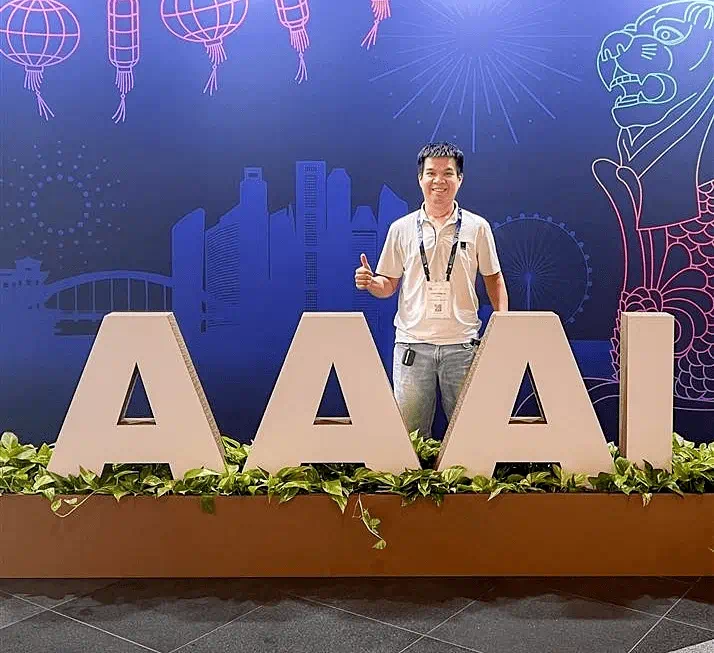
Dr. Tran Van Khanh presents on behalf of the SAGE research team at AAAI-26.
SAGE simulates group learning sessions with AI “peers” assigned different roles. According to Dr. Khanh, the system includes a coordinator AI managing progress, a subject-matter expert AI providing knowledge support, and a motivator AI encouraging learners. What distinguishes SAGE is its ability to “know when to speak and when to stay silent.” The AI agents operate autonomously, avoiding premature answers and instead offering guidance when necessary, following the educational “scaffolding” method—providing more support initially and gradually reducing it as learners gain mastery.
Dr. Khanh explained that the research emerged from the convergence of academic inquiry and industry practice, addressing the concern that while AI is strong in answering questions, it still lacks human-like and pedagogical qualities. Experimental results on Grade 12-level tasks show that SAGE achieved over 72% pedagogical effectiveness, outperforming conventional methods. “When AI knows when to step back, learners become more proactive instead of relying on ready-made answers,” he noted.
A key challenge for the team is the cost and latency of running multiple AI agents simultaneously. Nevertheless, Dr. Khanh envisions building intelligent virtual classrooms where AI acts not just as a tool but as a companion, helping bridge knowledge gaps. For him, participating in AAAI-26 demonstrates that educational challenges in Vietnam can be addressed with globally competitive technology.
These two research projects are seen as foundational for further development, enabling FPT’s experts to translate advanced technologies into practical value, aligned with the corporation’s strategy of mastering core technologies.