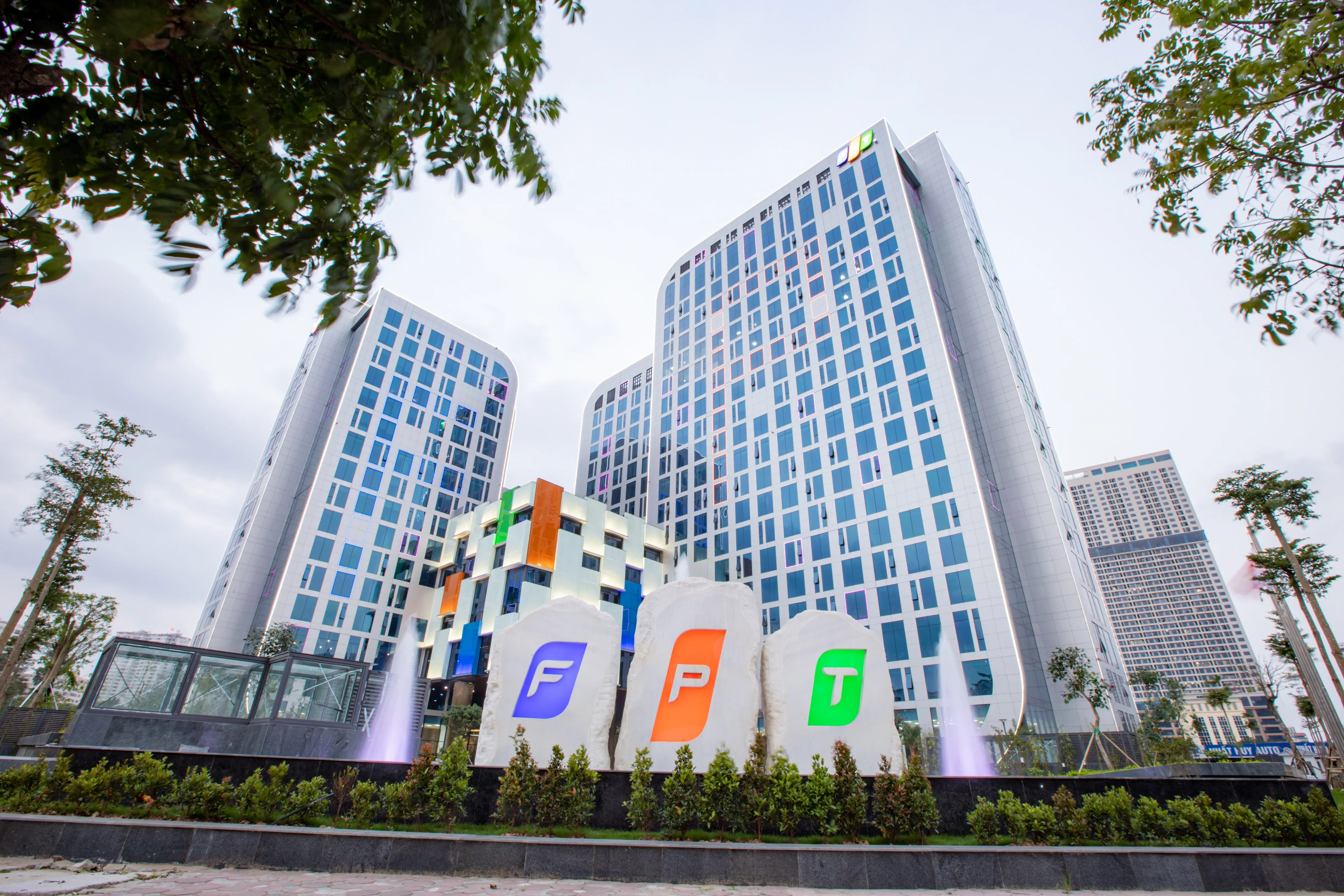
TIME names FPT and FPT Retail among Asia-Pacific’s Best Companies 2026
•
14/02/2026
This year, FPT and five other Vietnamese companies maintained their positions in the ranking of the best companies in Asia-Pacific, while FPT Retail (under FPT Corporation), Vietnam Airlines, and Hoang Anh Gia Lai made their first appearance on the list.
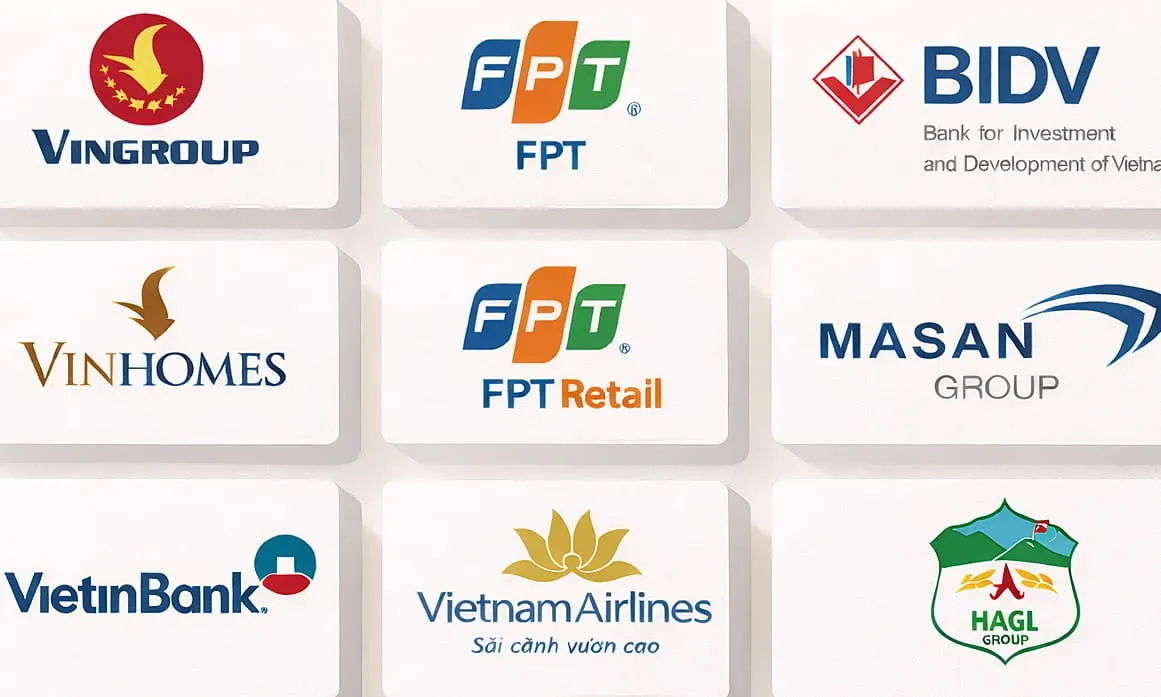
TIME magazine has announced the 2026 ranking of Asia-Pacific’s Best Companies, featuring nine representatives from Vietnam. This marks the second year the ranking has been published, following its debut in 2025.
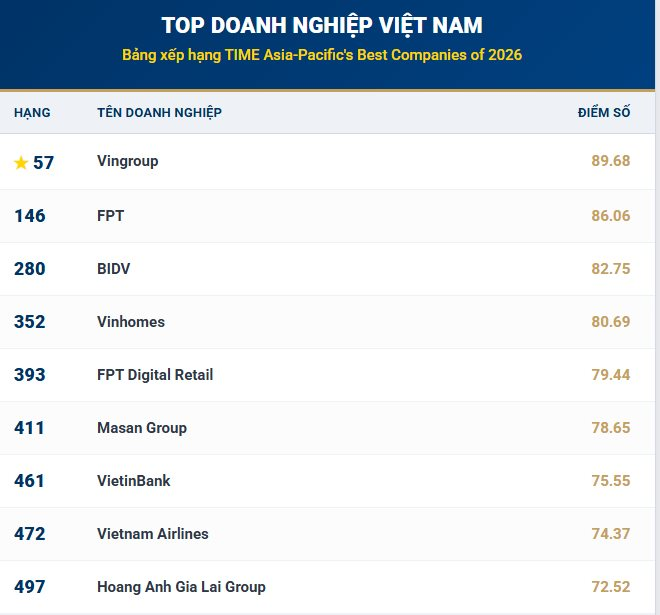
This year’s list includes Vietnamese enterprises across a wide range of sectors, from real estate, technology, and banking to consumer goods, aviation, and agriculture. Vingroup achieved the highest position among Vietnamese companies, ranking 57th.
In the technology and retail segment, the FPT ecosystem contributed two representatives. FPT Corporation ranked 146th with a score of 86.06, reflecting strong and sustainable growth in its technology segment, with post-tax profit reaching VND 9,369 billion by the end of 2025. Notably, FPT Retail also entered the ranking at position 393 (79.44 points). Growth driven by the FPT Long Chau pharmacy chain enabled the company to achieve a pre-tax profit exceeding VND 1,219 billion.
The banking sector saw two representatives: BIDV and VietinBank, ranking 280th and 461st respectively. In 2025, VietinBank recorded pre-tax profit of VND 43,446 billion, while BIDV reached VND 37,863 billion.
In the consumer sector, Masan Group ranked 411th, with post-tax profit of VND 6,764 billion, up 58% year-on-year. Vietnam Airlines ranked 472nd following its restructuring, reporting post-tax profit of VND 7,713 billion. Meanwhile, Hoang Anh Gia Lai ranked 497th, achieving post-tax profit of VND 2,243 billion and eliminating accumulated losses.
Compared to the previous year, the number of Vietnamese representatives increased to nine companies, with three new entrants—FPT Retail, Vietnam Airlines, and Hoang Anh Gia Lai—reflecting strong growth in pharmaceutical retail, recovery in aviation, and improved efficiency in large-scale agriculture.
According to independent assessments by TIME and Statista, companies were selected based on three key criteria: financial growth, employee satisfaction, and transparency in sustainable development (ESG). Financial performance was measured through revenue and profit growth during the 2022–2024 period, while employee satisfaction was evaluated through workforce surveys across multiple regional markets. ESG criteria included governance, environmental impact, labor policies, anti-corruption practices, and disclosure, with equal weighting.
The ranking also indicates that Asia-Pacific companies are adapting more effectively to global economic fluctuations. Following a period of instability in early 2025, the business environment has gradually stabilized as economies adjust strategies, reduce reliance on the U.S. market, and strengthen intra-regional cooperation.
Among the top 500 companies in the region, banking and financial services continue to dominate. DBS Bank leads the ranking, followed by Commonwealth Bank, driven by stable profitability and strong technology adoption. The automotive sector also demonstrated resilience amid sustained demand for electric and hybrid vehicles, with Toyota, Hyundai, and Honda among the leading companies.
Several Chinese companies, including Xiaomi, BYD, and Geely, are also featured, reflecting a shift toward technology and clean energy. Insurance and healthcare sectors continue to grow, represented by companies such as QBE Insurance Group, AIA Group, and SBI Life Insurance.
By country, Australia has a strong presence among top-ranked companies, while India leads in total number of companies listed. Overall, this year’s ranking highlights a broader trend of strategic repositioning, enhanced adaptability, and a focus on sustainable growth across the region.
Although the number of Vietnamese companies remains modest compared to larger economies, their presence across multiple sectors demonstrates clear progress in improving growth quality, strengthening governance, and aligning with international standards.