FPT CEO: Businesses Must Shift from “Using AI” to “Integrating AI” to Build Competitive Advantage
•
08/05/2026
Hanoi, May 7, 2026 – At the Cisco CxO Symposium 2026 Vietnam, Mr. Nguyen Van Khoa, Chief Executive Officer of FPT Corporation, shared practical insights into how businesses can leverage artificial intelligence (AI) in management and operations, emphasizing the critical role of leadership and data in the new era.
Cisco CxO Symposium 2026 brought together business leaders and technology experts to discuss trends and strategies for AI adoption. At the event, Cisco highlighted the message “Architecture of Trust” — a foundational architecture enabling enterprises to build trust, ensure security, and scale AI deployment effectively. In this context, Mr. Nguyen Van Khoa’s presentation offered a practical business perspective and a methodology for AI transformation to address operational and management challenges in the AI era.
Speaking at the event, Mr. Nguyen Van Khoa, Chief Executive Officer of FPT Corporation, stated that AI is opening a “golden opportunity” for Vietnamese enterprises to narrow the gap with the world. According to him, each generation has a defining technological breakthrough, and AI represents the current opportunity for Vietnam to “start on the same line” as developed countries, particularly in software and data.
Drawing from FPT’s own experience, Mr. Nguyen Van Khoa shared that with a workforce of approximately 85,991 employees (including affiliates), operational challenges require technology-driven optimization. He noted that AI adoption has improved productivity by around 30% in certain activities without changing headcount size. This trend mirrors that of many global technology companies, including Cisco, which reported approximately 30% productivity growth while expanding by around 5,000 employees. “Without fundamental changes in operational models, businesses will struggle to grow in this period,” he emphasized.
At the event, Mr. Nguyen Van Khoa introduced the FPT CASAN framework — five levels of AI maturity: Curious, Augmented, Standard, Automatic, and Native. The framework outlines the journey from individuals experimenting with AI to organizations embedding AI as a core capability. According to him, most Vietnamese businesses are currently at Levels 1–2, and the key transition lies in integrating AI into processes and operations at higher levels.
“The important thing is not chasing AI trends, but applying AI to solve the right organizational challenges,” Mr. Nguyen Van Khoa shared.
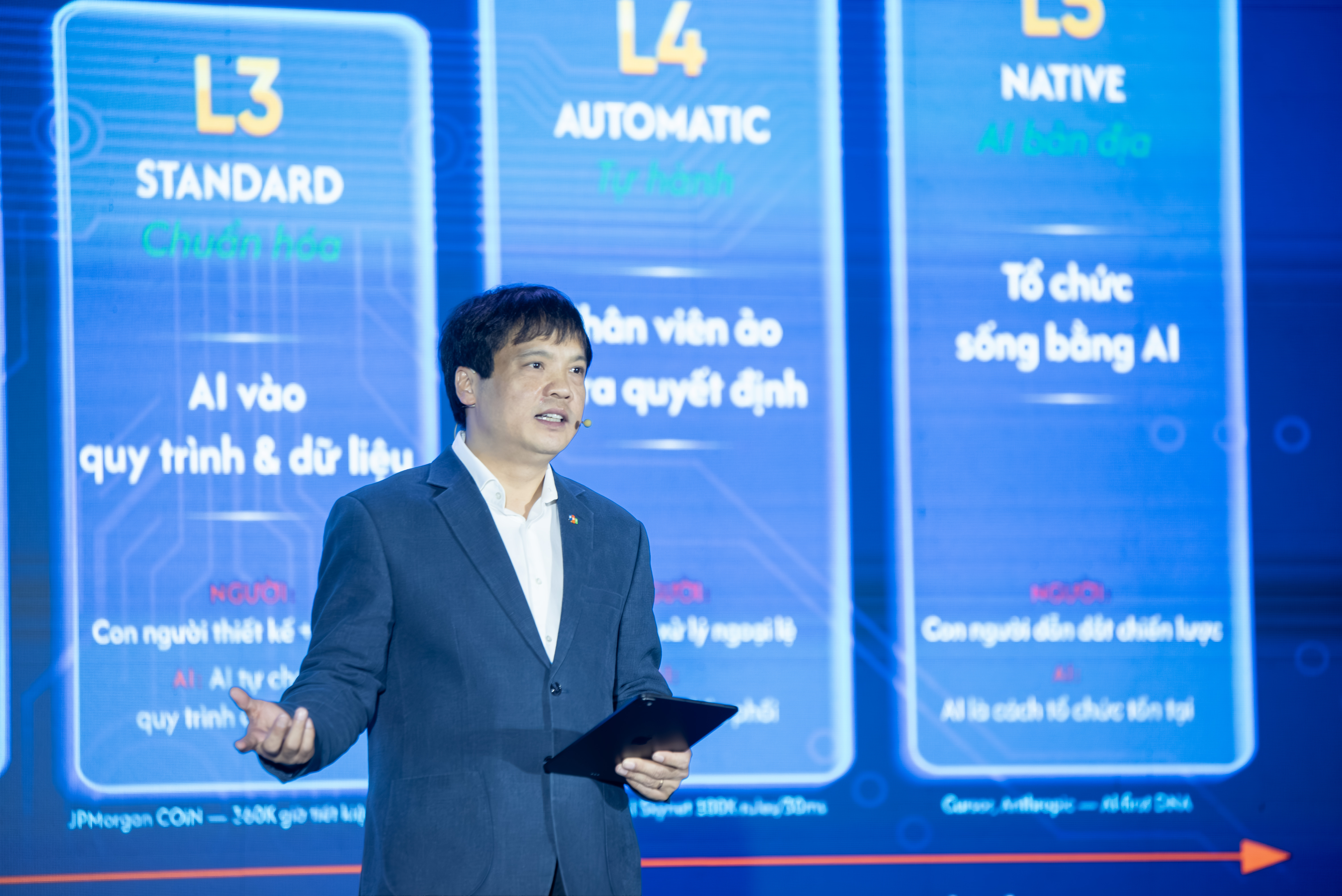
Mr. Nguyen Van Khoa, Chief Executive Officer of FPT Corporation, shared practical perspectives on how businesses can leverage AI in management and operations.
Highlighting the human factor in AI transformation, Mr. Nguyen Van Khoa stressed that leadership plays a decisive role. “If the CEO or Chairman is not directly involved in driving AI transformation, that organization is unlikely to succeed,” he said.
According to Mr. Nguyen Van Khoa, AI transformation is not merely a technology challenge but a comprehensive shift in management thinking. Businesses must move away from experience-based and manual operations toward data-driven management, where decisions are made based on analytics and technology.
Drawing from implementation experience, Mr. Nguyen Van Khoa outlined five major shifts in management mindset that FPT has undertaken, starting with eliminating outdated habits: no longer relying on manual approval processes; no longer measuring productivity by working hours; no longer treating cybersecurity as solely the IT department’s responsibility; no longer viewing AI as a one-time investment; and no longer using AI with the goal of replacing humans. Instead, enterprises should automate operations, measure performance based on value creation, strengthen leadership responsibility in risk governance, treat AI as an ongoing operational resource, and use AI to enhance human capabilities.
Notably, FPT approaches AI as a “digital workforce” — not merely a support tool but as a “salaried employee” within the organization. Accordingly, AI is allocated operational budgets, assigned KPIs, and evaluated periodically for effectiveness. At the same time, FPT has introduced a “token-based reward” mechanism to encourage employees to utilize AI effectively in their work. This approach enables AI to become an integrated part of the company’s operational system while establishing a new governance model that combines human and AI collaboration.
Mr. Nguyen Van Khoa also affirmed that AI cannot fully replace humans, particularly in areas requiring emotion and empathy. According to him, AI should be viewed as an “assistant” or “copilot” that helps people improve productivity and work quality. At the same time, the AI era presents a major opportunity for Vietnamese enterprises to accelerate growth.
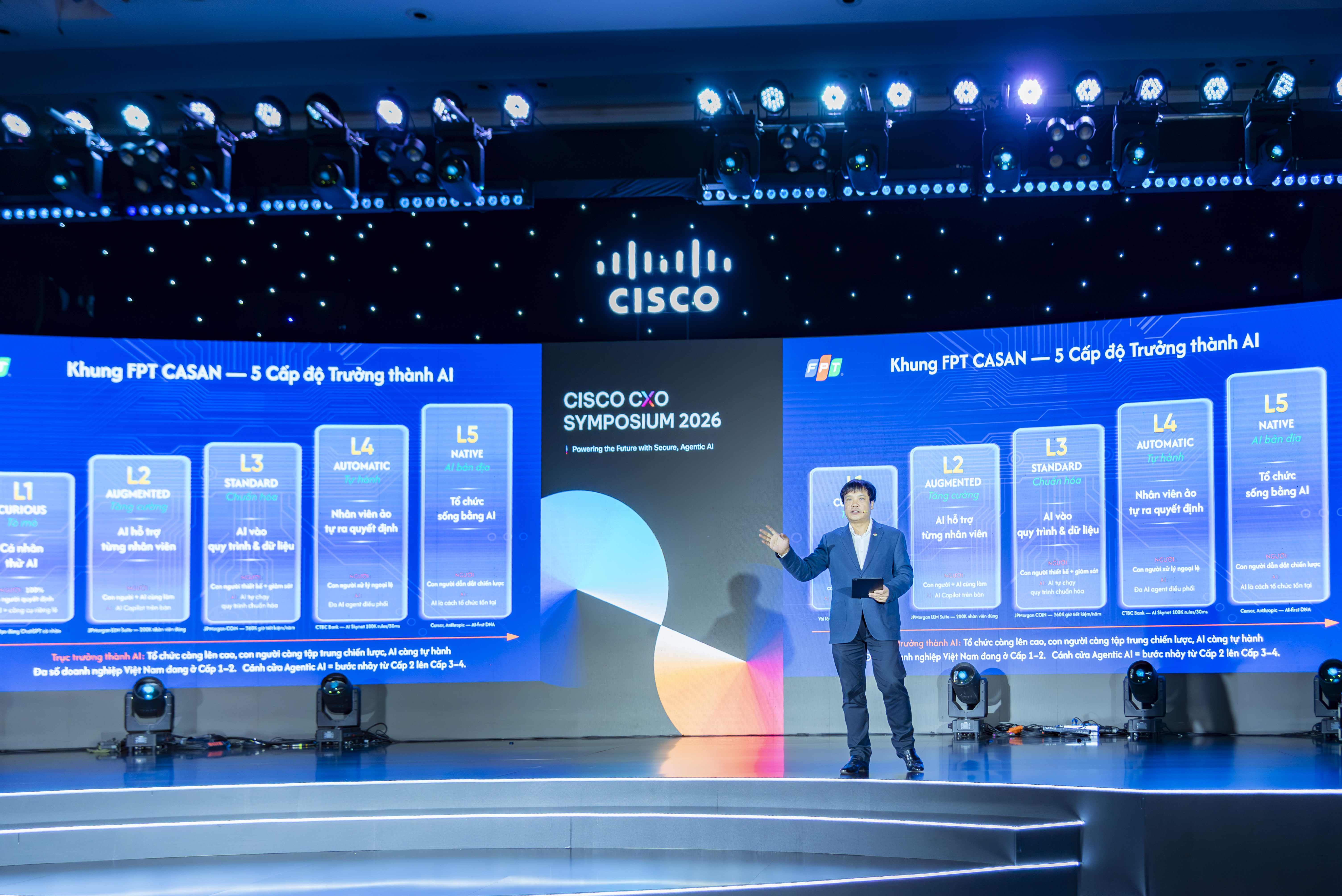
Cisco CxO Symposium 2026 gathered business leaders and technology experts to discuss AI trends, strategies, and enterprise applications.
Also at the Cisco CxO Symposium 2026 Vietnam on May 7, Mr. Nguyen Quang Minh, Director of the AI Consulting & Innovation Center (AI Lab), FPT Smart Cloud, FPT Corporation, shared perspectives on how enterprises can break through in the AI era through appropriate adoption strategies and effective implementation of AI Agents Workspace models. According to him, AI is shifting from an experimental phase toward delivering practical experiences and tangible business value. In this context, AI Workspace serves as a foundational platform enabling organizations to operate AI agents systematically and intelligently while strengthening collaboration between humans and AI in workflows.
With the ambition of building a strong technological foundation, FPT began investing in AI as early as 2013, when AI was still a relatively new concept in Vietnam. Throughout this journey, FPT has pioneered research, product and solution development, talent training, and partnerships with leading global AI organizations and enterprises. To date, FPT is developing a Vietnamese large language model with 70 billion parameters, trained on 112 billion tokens, integrated into AI solutions serving 5 million regular users. Nearly 100% of FPT employees have received AI training. The corporation has also partnered with NVIDIA to build two AI factories in Vietnam and Japan and introduced AI education for students starting from Grade 1. Most recently, FPT established the Quantum AI & Cybersecurity Research Institute (QACI), focusing on research and solution development, doctoral and high-level expert training, and international collaboration.