FPT Chairman Truong Gia Binh: Ho Chi Minh City can become the drone capital of the region
•
09/12/2025
At a meeting between Ho Chi Minh City leaders and the local science–technology and innovation–startup community on the afternoon of December 9, FPT Chairman Truong Gia Binh shared strategic insights on international cooperation opportunities and the potential to build a low-altitude economy—particularly the unmanned aerial vehicle (UAV) industry—in Ho Chi Minh City and Vietnam at large.
The event was chaired by Mr. Tran Luu Quang, Member of the Party Central Committee and Secretary of the Ho Chi Minh City Party Committee, under the theme: “Ho Chi Minh City toward becoming a regional Digital Economy Center and an International Hub for Innovation and Startups.”
Reporting to the City’s leadership, Mr. Truong Gia Binh said the Low-Altitude Economy Alliance—which includes FPT and several relevant enterprises—is working with Ho Chi Minh City to develop a UAV industry valued at USD 10 billion within the next decade, creating around one million jobs. To achieve this ambition, Vietnam would need to sustain an annual growth rate of 60–70%, twice the global average. “We dream of building a drone capital in Vietnam,” Mr. Binh affirmed.
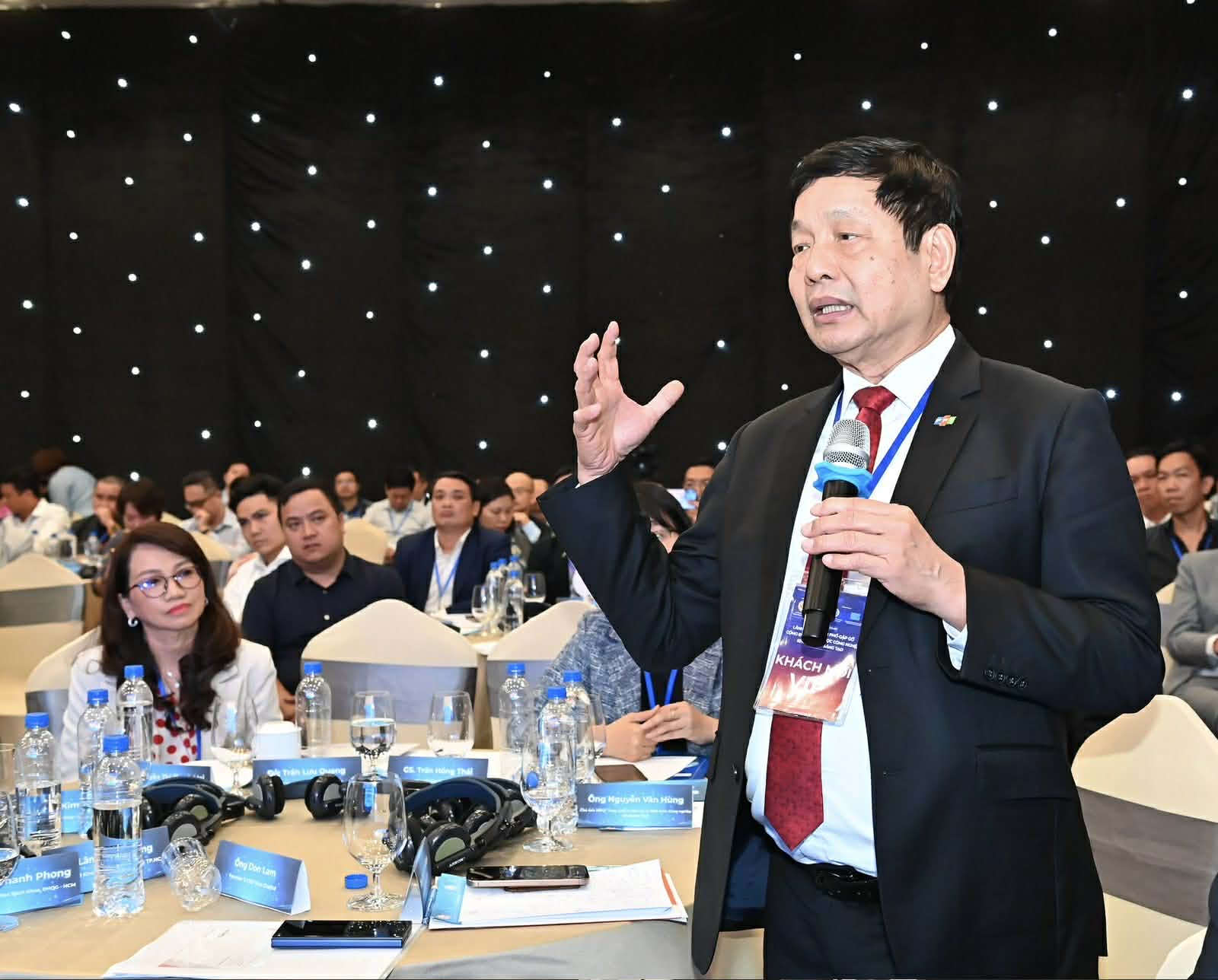
Photo – FPT Chairman Truong Gia Binh speaking at the meeting with Ho Chi Minh City leadership and the science–technology community. Photo: Viet Dung – SGGP
According to Mr. Binh, Japanese partners have shared that Japan is preparing to announce 17 strategic technologies this year. The country is also shifting its international cooperation strategy, moving from bilateral engagements to broader collaboration across Southeast Asia—with Vietnam designated as the top priority.
Japan has shown strong interest in developing the low-altitude economy. However, implementation in Vietnam remains difficult due to the lack of a completed legal and regulatory framework.
Mr. Binh said he had invited Japanese partners to pilot their technologies in Vietnam first, with the intention that once Vietnam finalizes its legal framework, these models could then be applied back in Japan.
“Japanese partners are not only looking for bilateral cooperation; they aim to build UAV production for the global market,” he added.
The biggest bottleneck: Vietnam’s missing regulatory framework
Vietnam currently lacks essential legal definitions and mechanisms for the UAV industry, including a sandbox framework, technical standards, licensing procedures, and certifications of origin.
According to Mr. Binh, Japan is ready to support Vietnam in building a complete regulatory system for the sector.
He proposed that Ho Chi Minh City allow FPT to participate directly in developing the City’s UAV sandbox as a precursor to scaling a national framework.
At present, Vietnam’s UAV market is valued at only around USD 100 million annually, but the target is to grow this figure one hundredfold over the next decade. Mr. Binh emphasized that Vietnam’s competitive advantages—particularly labor cost efficiency and strong software development capabilities—position the country well to compete globally.
“Software is the field where we can win on almost any playing field. I believe the low-altitude economy will be no different,” he said.
Clarifying the low-altitude economy: Production or application?
During the dialogue, Secretary Tran Luu Quang asked a key question: Should Vietnam focus on manufacturing UAVs or on applying UAVs widely in daily life?
In response, Mr. Binh said UAVs will ultimately become part of national defense capability, and Vietnam’s greatest opportunity lies in manufacturing for global demand—especially given today’s severe global supply shortages.
Regarding applications, he noted that agriculture offers the largest potential, with many successful pilot models already deployed. UAV delivery services are also feasible provided Vietnam develops a standardized national digital addressing system.
Ho Chi Minh City’s vision: Becoming a national and international innovation hub
City leaders listened to scientists, technology experts, and startups on how Ho Chi Minh City can advance toward becoming both a national digital economy center and an international-level innovation hub. Participants discussed policies and mechanisms to accelerate science, technology, and innovation; and how these sectors could contribute more substantially to the City’s socioeconomic development.
In closing remarks, Secretary Tran Luu Quang stressed that advancing science and technology is not optional—it is essential, not only for the City but for the entire nation. Although Ho Chi Minh City must simultaneously tackle urgent issues such as flooding, congestion, pollution, and drug-related challenges, progress in science and technology will ultimately help resolve these problems.
He emphasized that the City must pay special attention to the science–technology sector. Institutional reforms must go beyond incentives and include administrative modernization to truly support innovation.